






 9FXT
9FXT
L2A5 Fab in complex with STn-Ser
9FXT の概要
| エントリーDOI | 10.2210/pdb9fxt/pdb |
| 関連するPDBエントリー | 9FY8 |
| 関連するBIRD辞書のPRD_ID | PRD_002573 |
| 分子名称 | L2A5 Fab Heavy Chain, Anti kappa Variable Heavy Chain, L2A5 Fab Light Chain, ... (8 entities in total) |
| 機能のキーワード | antibody, fab, sugar binding protein |
| 由来する生物種 | Homo sapiens 詳細 |
| タンパク質・核酸の鎖数 | 6 |
| 化学式量合計 | 119585.97 |
| 構造登録者 | |
| 主引用文献 | Soares, C.O.,Laugieri, M.E.,Grosso, A.S.,Natale, M.,Coelho, H.,Behren, S.,Yu, J.,Cai, H.,Franconetti, A.,Oyenarte, I.,Magnasco, M.,Gimeno, A.,Ramos, N.,Chai, W.,Corzana, F.,Westerlind, U.,Jimenez-Barbero, J.,Palma, A.S.,Videira, P.A.,Ereno-Orbea, J.,Marcelo, F. Decoding the Molecular Basis of the Specificity of an Anti-sTn Antibody. Jacs Au, 5:225-236, 2025 Cited by PubMed Abstract: The mucin -glycan sialyl Tn antigen (sTn, Neu5Acα2-6GalNAcα1--Ser/Thr) is an antigen associated with different types of cancers, often linked with a higher risk of metastasis and poor prognosis. Despite efforts to develop anti-sTn antibodies with high specificity for diagnostics and immunotherapy, challenges in eliciting high-affinity antibodies for glycan structures have limited their effectiveness, leading to low titers and short protection durations. Experimental structural insights into anti-sTn antibody specificity are lacking, hindering their optimization for cancer cell recognition. In this study, we used a comprehensive structural approach, combining X-ray crystallography, NMR spectroscopy, computational methods, glycan/glycopeptide microarrays, and biophysical techniques, to thoroughly investigate the molecular basis of sTn recognition by L2A5, a novel preclinical anti-sTn monoclonal antibody (mAb). Our data unequivocally show that the L2A5 fragment antigen-binding (Fab) specifically binds to core sTn moieties. NMR and X-ray structural data suggest a similar binding mode for the complexes formed by the sTn moiety linked to Ser or Thr and the L2A5 Fab. The sugar moieties are similarly oriented in the paratope of mAb, with the Neu5Ac moiety establishing key interactions with the receptor and the GalNAc moiety providing additional contacts. Furthermore, L2A5 exhibits fine specificity toward cancer-related MUC1 and MUC4 mucin-derived sTn glycopeptides, which might contribute to its selective targeting against tumor cells. This newfound knowledge holds promise for the rational improvement and potential application of this anti-sTn antibody in diagnosis and targeted therapy against sTn expressing cancers such as breast, colorectal, and bladder cancer, improving patient care. PubMed: 39886580DOI: 10.1021/jacsau.4c00921 主引用文献が同じPDBエントリー |
| 実験手法 | X-RAY DIFFRACTION (2.3 Å) |
構造検証レポート
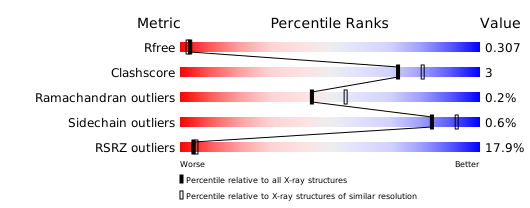
検証レポート(詳細版) をダウンロード
をダウンロード


