






 9FPP
9FPP
FGD2 (Rv0132c) from Mycobacterium tuberculosis with cofactor F420 crystallised with Anderson-Evans polyoxotungstate
Summary for 9FPP
| Entry DOI | 10.2210/pdb9fpp/pdb |
| Related | 9FP4 |
| Descriptor | F420-dependent hydroxymycolic acid dehydrogenase, 6-tungstotellurate(VI), IMIDAZOLE, ... (6 entities in total) |
| Functional Keywords | fgd2, f420, tuberculosis, deazaflavin, flavin, cofactor, tew, glucose, mtb, mycobacterium, tim barrel, oxidoreductase |
| Biological source | Mycobacterium tuberculosis H37Rv |
| Total number of polymer chains | 4 |
| Total formula weight | 156596.35 |
| Authors | Aderemi, A.,Snee, M.,Levy, C.,Leys, D. (deposition date: 2024-06-13, release date: 2025-06-25, Last modification date: 2026-04-29) |
| Primary citation | Aderemi, A.V.,Snee, M.,Tunnicliffe, R.B.,Johanissen, L.O.,Cliff, M.J.,Levy, C.W.,Heyes, D.J.,Golovanova, M.,Jowitt, T.A.,Hay, S.,Munro, A.W.,Waltho, J.P.,Leys, D. The Mycobacterium tuberculosis Rv0132c Gene Product Mtb-FGD2 Can Act as an F 420 -Dependent Glucose Dehydrogenase. Proteins, 2026 Cited by PubMed Abstract: The role of the cell envelope-associated Rv0132c/FGD2 from Mycobacterium tuberculosis has long been a subject of debate. Importantly, FGD2 is found only in pathogenic mycobacteria, making it a potential drug target. While some suggest it functions as a glucose-6-phosphate dehydrogenase, others propose it acts instead as an F-dependent hydroxy-mycolic acid dehydrogenase-an activity linked to cell-wall remodeling and inhibition by the anti-tubercular drug pretomanid. Yet, direct evidence for either activity has been lacking. Here, we heterologously express and purify active Mtb-FGD2, and demonstrate that the enzyme binds the F cofactor with nanomolar affinity. Crystal structures for both the apo-form and the F complex reveal that the Mtb-FGD2 active site architecture is consistent with sugar substrates but notably lacks a phosphate-binding pocket. Biochemical assays confirm that Mtb-FGD2 functions efficiently as an F-dependent glucose dehydrogenase in vitro. Computational docking combined with molecular dynamics simulations further supports the formation of a catalytically plausible β-D-glucose:F ternary complex. When coupled to other F-dependent enzymes, Mtb-FGD2 readily supports glucose-driven F.H-dependent oxidoreductase activity. Our data thus suggest that the Mtb-FGD2 provides reduced F.H in a glucose-dependent manner to support mycobacterial F.H-dependent oxidoreductases in the cell envelope. PubMed: 42012189DOI: 10.1002/prot.70139 PDB entries with the same primary citation |
| Experimental method | X-RAY DIFFRACTION (2.35 Å) |
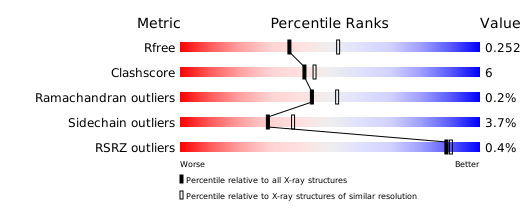
Structure validation
Download full validation report


