






9FMS
Cryo-EM structure of S. cerevisiae Rai1-Rat1-Rtt103(252-273) complex.
9FMS の概要
| エントリーDOI | 10.2210/pdb9fms/pdb |
| 関連するPDBエントリー | 8Q6V 9EXS |
| EMDBエントリー | 18199 50048 50566 |
| 分子名称 | 5'-3' exoribonuclease 2, Regulator of Ty1 transposition protein 103, Decapping nuclease RAI1, ... (4 entities in total) |
| 機能のキーワード | rai1 nuclease, rtt103 binding, structured, rna binding, rna binding protein |
| 由来する生物種 | Saccharomyces cerevisiae (brewer's yeast) 詳細 |
| タンパク質・核酸の鎖数 | 3 |
| 化学式量合計 | 163135.08 |
| 構造登録者 | |
| 主引用文献 | Dikunova, A.,Noskova, N.,Overbeck, J.H.,Polak, M.,Stelzig, D.,Zapletal, D.,Kubicek, K.,Novacek, J.,Sprangers, R.,Stefl, R. Assembly of the Xrn2/Rat1-Rai1-Rtt103 termination complexes in mesophilic and thermophilic organisms. Structure, 33:300-, 2025 Cited by PubMed Abstract: The 5'-3' exoribonuclease Xrn2, known as Rat1 in yeasts, terminates mRNA transcription by RNA polymerase II (RNAPII). In the torpedo model of termination, the activity of Xrn2/Rat1 is enhanced by Rai1, which is recruited to the termination site by Rtt103, an adaptor protein binding to the RNAPII C-terminal domain (CTD). The overall architecture of the Xrn2/Rat1-Rai1-Rtt103 complex remains unknown. We combined structural biology methods to characterize the torpedo complex from Saccharomyces cerevisiae and Chaetomium thermophilum. Comparison of the structures from these organisms revealed a conserved protein core fold of the subunits, but significant variability in their interaction interfaces. We found that in the mesophile, Rtt103 utilizes an unstructured region to augment a Rai1 β-sheet, while in the thermophile Rtt103 binds to a C-terminal helix of Rai1 via its CTD-interacting domain with an α-helical fold. These different torpedo complex assemblies reflect adaptations to the environment and impact complex recruitment to RNAPII. PubMed: 39657659DOI: 10.1016/j.str.2024.11.010 主引用文献が同じPDBエントリー |
| 実験手法 | ELECTRON MICROSCOPY (2.65 Å) |
構造検証レポート
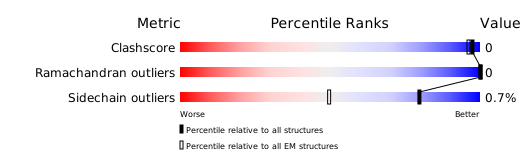
検証レポート(詳細版) をダウンロード
をダウンロード


