






9FCV
Cas nuclease-CRISPR (cr)RNA ribonucleoprotein (RNP) complex
9FCV の概要
| エントリーDOI | 10.2210/pdb9fcv/pdb |
| EMDBエントリー | 50322 |
| 分子名称 | Phage head-tail adaptor, crRNA (2 entities in total) |
| 機能のキーワード | acrvib1; anti-crispr protein; cas13b, rna binding protein |
| 由来する生物種 | Segatella buccae 詳細 |
| タンパク質・核酸の鎖数 | 2 |
| 化学式量合計 | 160181.29 |
| 構造登録者 | |
| 主引用文献 | Wandera, K.G.,Schmelz, S.,Migur, A.,Kibe, A.,Lukat, P.,Achmedov, T.,Caliskan, N.,Blankenfeldt, W.,Beisel, C.L. AcrVIB1 inhibits CRISPR-Cas13b immunity by promoting unproductive crRNA binding accessible to RNase attack. Mol.Cell, 85:1162-, 2025 Cited by PubMed Abstract: Anti-CRISPR proteins (Acrs) inhibit CRISPR-Cas immune defenses, with almost all known Acrs acting on the Cas nuclease-CRISPR (cr)RNA ribonucleoprotein (RNP) complex. Here, we show that AcrVIB1 from Riemerella anatipestifer, the only known Acr against Cas13b, principally acts upstream of RNP complex formation by promoting unproductive crRNA binding followed by crRNA degradation. AcrVIB1 tightly binds to Cas13b but not to the Cas13b-crRNA complex, resulting in enhanced rather than blocked crRNA binding. However, the more tightly bound crRNA does not undergo processing and fails to activate collateral RNA cleavage even with target RNA. The bound crRNA is also accessible to RNases, leading to crRNA turnover in vivo even in the presence of Cas13b. Finally, cryoelectron microscopy (cryo-EM) structures reveal that AcrVIB1 binds a helical domain of Cas13b responsible for securing the crRNA, keeping the domain untethered. These findings reveal an Acr that converts an effector nuclease into a crRNA sink to suppress CRISPR-Cas defense. PubMed: 39965569DOI: 10.1016/j.molcel.2025.01.020 主引用文献が同じPDBエントリー |
| 実験手法 | ELECTRON MICROSCOPY (3.09 Å) |
構造検証レポート
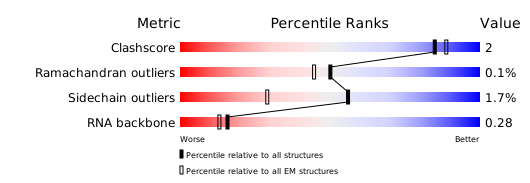
検証レポート(詳細版) をダウンロード
をダウンロード


