






 9FAE
9FAE
Human adenovirus type 36 fiber knob in complex with 4-O-acetyl-3'-sialyllactose
9FAE の概要
| エントリーDOI | 10.2210/pdb9fae/pdb |
| 分子名称 | Fiber, 4-O-acetyl-5-acetamido-3,5-dideoxy-D-glycero-alpha-D-galacto-non-2-ulopyranosonic acid-(2-3)-beta-D-galactopyranose, 4-O-acetyl-5-acetamido-3,5-dideoxy-D-glycero-alpha-D-galacto-non-2-ulopyranosonic acid, ... (4 entities in total) |
| 機能のキーワード | fiber knob, complex, sialic acid, viral protein |
| 由来する生物種 | Human adenovirus 36 |
| タンパク質・核酸の鎖数 | 3 |
| 化学式量合計 | 121708.11 |
| 構造登録者 | Strebl, M.,Liaci, A.M.,Pfenning, V.,Stehle, T. (登録日: 2024-05-10, 公開日: 2025-01-22, 最終更新日: 2025-02-12) |
| 主引用文献 | Liaci, A.M.,Chandra, N.,Vodnala, S.M.,Strebl, M.,Kumar, P.,Pfenning, V.,Bachmann, P.,Caraballo, R.,Chai, W.,Johansson, E.,Elofsson, M.,Feizi, T.,Liu, Y.,Stehle, T.,Arnberg, N. Extended receptor repertoire of an adenovirus associated with human obesity. Plos Pathog., 21:e1012892-e1012892, 2025 Cited by PubMed Abstract: Human adenovirus type 36 (HAdV-D36) has been putatively linked to obesity in animals and has been associated with obesity in humans in some but not all studies. Despite extensive epidemiological research there is limited information about its receptor profile. We investigated the receptor portfolio of HAdV-D36 using a combined structural biology and virology approach. The HAdV-D36 fiber knob domain (FK), which mediates the primary attachment of many HAdVs to host cells, has a significantly elongated DG loop that alters known binding interfaces for established adenovirus receptors such as the coxsackie- and adenovirus receptor (CAR) and CD46. Our data suggest that HAdV-D36 attaches to host cells using a versatile receptor pool comprising sialic acid-containing glycans and CAR. Sialic acids are recognized at the same binding site used by other HAdVs of species D such as HAdV-D37. Using glycan microarrays, we demonstrate that HAdV-D36 displays a binding preference for glycans containing a rare sialic acid variant, 4-O,5-N-diacetylneuraminic acid, over the more common 5-N-acetylneuraminic acid. To date, this sialic acid variant has not been detected in humans, although it can be synthesized by various animal species, including a range of domestic and livestock animals. Taken together, our results indicate that HAdV-D36 has evolved to recognize a specialized set of primary attachment receptors that are different from known HAdV types and coincides with a unique host range and pathogenicity profile. PubMed: 39883726DOI: 10.1371/journal.ppat.1012892 主引用文献が同じPDBエントリー |
| 実験手法 | X-RAY DIFFRACTION (1.5735397337 Å) |
構造検証レポート
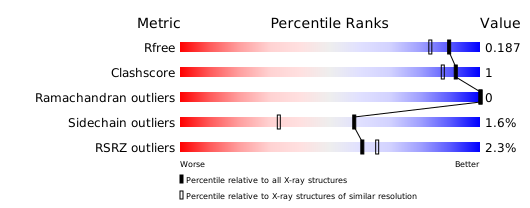
検証レポート(詳細版) をダウンロード
をダウンロード


