






9F90
Crystal structure of a designed three-motif Respiratory Syncytial Virus immunogen in complex with motavizumab fab
Summary for 9F90
| Entry DOI | 10.2210/pdb9f90/pdb |
| Descriptor | Motavizumab Fab light chain, Motavizumab Fab heavy chain, RSVF-multi-epitope designed scaffold, ... (5 entities in total) |
| Functional Keywords | designed immunogen, specific binding, rsv f protein, de novo protein |
| Biological source | Mus musculus More |
| Total number of polymer chains | 6 |
| Total formula weight | 126688.66 |
| Authors | Castro, K.M.,Correia, B.E. (deposition date: 2024-05-07, release date: 2025-05-21, Last modification date: 2025-12-17) |
| Primary citation | Castro, K.M.,Watson, J.L.,Wang, J.,Southern, J.,Ayardulabi, R.,Georgeon, S.,Rosset, S.,Baker, D.,Correia, B.E. Accurate single-domain scaffolding of three nonoverlapping protein epitopes using deep learning. Nat.Chem.Biol., 2025 Cited by PubMed Abstract: De novo protein design has seen major success in scaffolding single functional motifs; however, in nature, most proteins present multiple functional sites. Here, we describe an approach to simultaneously scaffold multiple functional sites in a single-domain protein using deep learning. We designed small single-domain immunogens, under 130 residues, that present three distinct and irregular motifs from respiratory syncytial virus. These motifs together comprise nearly half of the designed proteins; hence, the overall folds are quite unusual with little global similarity to proteins in the Protein Data Bank. Despite this, X-ray crystal structures confirmed the accuracy of presentation of each of the motifs and the multiepitope design yields improved cross-reactive titers and neutralizing response compared to a single-epitope immunogen. The successful presentation of three distinct binding surfaces in a small single-domain protein highlights the power of generative deep learning methods to solve complex protein design problems. PubMed: 41350440DOI: 10.1038/s41589-025-02083-z PDB entries with the same primary citation |
| Experimental method | X-RAY DIFFRACTION (2.91 Å) |
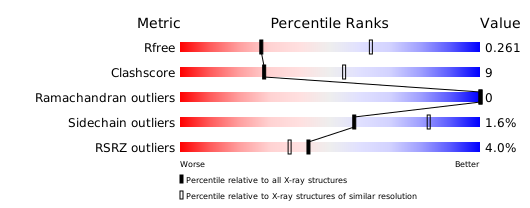
Structure validation
Download full validation report


