






 9F2D
9F2D
KIR2DL1 bound to RIFIN RBK21
9F2D の概要
| エントリーDOI | 10.2210/pdb9f2d/pdb |
| 分子名称 | RIFIN RBK21, KIR2DL protein, alpha-L-fucopyranose-(1-6)-2-acetamido-2-deoxy-beta-D-glucopyranose, ... (4 entities in total) |
| 機能のキーワード | plasmodium falciparum, malaria, rifin, kir, immune receptor, infected erythrocyte, immune system |
| 由来する生物種 | Plasmodium falciparum 詳細 |
| タンパク質・核酸の鎖数 | 16 |
| 化学式量合計 | 302337.63 |
| 構造登録者 | |
| 主引用文献 | Sakoguchi, A.,Chamberlain, S.G.,Morch, A.M.,Widdess, M.,Harrison, T.E.,Dustin, M.L.,Arase, H.,Higgins, M.K.,Iwanaga, S. RIFINs displayed on malaria-infected erythrocytes bind KIR2DL1 and KIR2DS1. Nature, 643:1363-1371, 2025 Cited by PubMed Abstract: Natural killer (NK) cells use inhibitory and activating immune receptors to differentiate between human cells and pathogens. Signalling by these receptors determines whether an NK cell becomes activated and destroys a target cell. In some cases, such as killer immunoglobulin-like receptors, immune receptors are found in pairs, with inhibitory and activating receptors containing nearly identical extracellular ligand-binding domains coupled to different intracellular signalling domains. Previous studies showed that repetitive interspersed family (RIFIN) proteins, displayed on the surfaces of Plasmodium falciparum-infected erythrocytes, can bind to inhibitory immune receptors and dampen NK cell activation, reducing parasite killing. However, no pathogen-derived ligand has been identified for any human activating receptor. Here we identified a clade of RIFINs that bind to inhibitory immune receptor KIR2DL1 more strongly than KIR2DL1 binds to the human ligand (MHC class I). This interaction mediates inhibitory signalling and suppresses the activation of KIR2DL1-expressing NK cells. We show that KIR2DL1-binding RIFINs are abundant in field-isolated strains from both Africa and Asia and reveal how the two RIFINs bind to KIR2DL1. The RIFIN binding surface of KIR2DL1 is conserved in the cognate activating immune receptor KIR2DS1. We find that KIR2DL1-binding RIFINs can also bind to KIR2DS1, resulting in the activation of KIR2DS1-expressing NK cells. This study demonstrates that activating killer immunoglobulin-like receptors can recruit NK cells to target a pathogen and reveals a potential role for activating immune receptors in controlling malaria infection. PubMed: 40500441DOI: 10.1038/s41586-025-09091-y 主引用文献が同じPDBエントリー |
| 実験手法 | X-RAY DIFFRACTION (2.886 Å) |
構造検証レポート
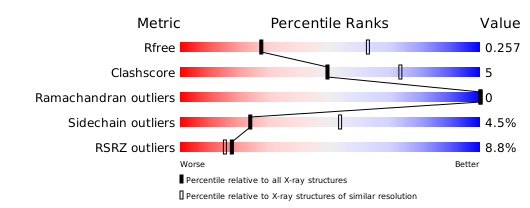
検証レポート(詳細版) をダウンロード
をダウンロード


