






 9EBS
9EBS9EBS の概要
| エントリーDOI | 10.2210/pdb9ebs/pdb |
| EMDBエントリー | 47889 |
| 分子名称 | Ubiquitin, WD repeat-containing protein 48, Ubiquitin carboxyl-terminal hydrolase 1, ... (6 entities in total) |
| 機能のキーワード | deubiquitination, pcna, allosteric inhibitor, hydrolase |
| 由来する生物種 | Homo sapiens (human) 詳細 |
| タンパク質・核酸の鎖数 | 3 |
| 化学式量合計 | 175041.61 |
| 構造登録者 | |
| 主引用文献 | Simoneau, A.,Pratt, C.B.,Wu, H.J.,Rajeswaran, S.S.,Comer, C.G.,Sudsakorn, S.,Zhang, W.,Liu, S.,Meier, S.R.,Choi, A.H.,Khendu, T.,Stowe, H.,Shen, B.,Whittington, D.A.,Chen, Y.,Yu, Y.,Mallender, W.D.,Feng, T.,Andersen, J.N.,Maxwell, J.P.,Throner, S. Characterization of TNG348: A Selective, Allosteric USP1 Inhibitor That Synergizes with PARP Inhibitors in Tumors with Homologous Recombination Deficiency. Mol.Cancer Ther., 24:678-691, 2025 Cited by PubMed Abstract: Inhibition of the deubiquitinating enzyme USP1 can induce synthetic lethality in tumors characterized by homologous recombination deficiency (HRD) and represents a novel therapeutic strategy for the treatment of BRCA1/2-mutant cancers, potentially including patients whose tumors have primary or acquired resistance to PARP inhibitors (PARPi). In this study, we present a comprehensive characterization of TNG348, an allosteric, selective, and reversible inhibitor of USP1. TNG348 induces dose-dependent accumulation of ubiquitinated protein substrates both in vitro and in vivo. CRISPR screens show that TNG348 exerts its antitumor effect by disrupting the translesion synthesis pathway of DNA damage tolerance through RAD18-dependent ubiquitinated PCNA. Although TNG348 and PARPi share the ability to selectively kill HRD tumor cells, CRISPR screens reveal that TNG348 and PARPi do so through discrete mechanisms. Particularly, knocking out PARP1 causes resistance to PARPi but sensitizes cells to TNG348 treatment. Consistent with these findings, combination of TNG348 with PARPi leads to synergistic antitumor effects in HRD tumors, resulting in tumor growth inhibition and regression in multiple mouse xenograft tumor models. Importantly, our data on human cancer models further show that the addition of TNG348 to PARPi treatment can overcome acquired PARPi resistance in vivo. Although the clinical development of TNG348 has been discontinued because of unexpected liver toxicity in patients (NCT06065059), the present data provide preclinical and mechanistic support for the continued exploration of USP1 as a drug target for the treatment of patients with BRCA1/2-mutant or HRD cancers. PubMed: 39886906DOI: 10.1158/1535-7163.MCT-24-0515 主引用文献が同じPDBエントリー |
| 実験手法 | ELECTRON MICROSCOPY (3.3 Å) |
構造検証レポート
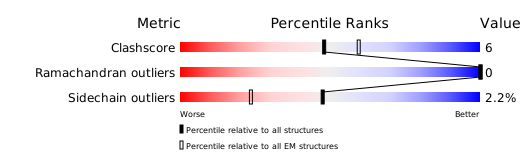
検証レポート(詳細版) をダウンロード
をダウンロード


