






 9EAH
9EAH
Structure of nanobody AT209 in complex with the olmesartan-bound angiotensin II type I receptor (AT1R)
9EAH の概要
| エントリーDOI | 10.2210/pdb9eah/pdb |
| EMDBエントリー | 47831 |
| 分子名称 | Nanobody AT209,Type-1 angiotensin II receptor,Soluble cytochrome b562, BAG2 Anti-BRIL Fab Heavy Chain, BAG2 Anti-BRIL Fab Light Chain, ... (5 entities in total) |
| 機能のキーワード | gpcr, at1r, nanobody, membrane protein |
| 由来する生物種 | Camelidae 詳細 |
| タンパク質・核酸の鎖数 | 4 |
| 化学式量合計 | 179276.53 |
| 構造登録者 | |
| 主引用文献 | Skiba, M.A.,Canavan, C.,Nemeth, G.R.,Liu, J.,Kanso, A.,Kruse, A.C. Epitope-directed selection of GPCR nanobody ligands with evolvable function. Proc.Natl.Acad.Sci.USA, 122:e2423931122-e2423931122, 2025 Cited by PubMed Abstract: Antibodies have the potential to target G protein-coupled receptors (GPCRs) with high receptor, cellular, and tissue selectivity; however, few antibody ligands for GPCRs exist. Here, we describe a generalizable selection method to enrich for GPCR ligands from a synthetic camelid antibody fragment (nanobody) library. Our strategy yielded multiple nanobody ligands for the angiotensin II type I receptor (AT1R), a prototypical GPCR and important drug target. We found that nanobodies readily act as allosteric modulators, encoding selectivity for both the receptor and chemical features of GPCR ligands. We then used structure-guided design to convert two nanobodies from allosteric ligands to competitive AT1R inhibitors through simple mutations. This work demonstrates that nanobodies can encode multiple pharmacological behaviors and have great potential as evolvable scaffolds for the development of next-generation GPCR therapeutics. PubMed: 40067891DOI: 10.1073/pnas.2423931122 主引用文献が同じPDBエントリー |
| 実験手法 | ELECTRON MICROSCOPY (3.1 Å) |
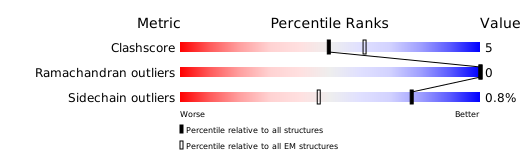
構造検証レポート
検証レポート(詳細版) をダウンロード
をダウンロード


