






9DYB
CHIP-TPR in complex with the phosphorylated Hsp70 tail
9DYB の概要
| エントリーDOI | 10.2210/pdb9dyb/pdb |
| 分子名称 | E3 ubiquitin-protein ligase CHIP, Heat shock 70 kDa protein 1A, CHLORIDE ION, ... (4 entities in total) |
| 機能のキーワード | ubiquitin ligase, chaperone, ligase |
| 由来する生物種 | Homo sapiens (human) 詳細 |
| タンパク質・核酸の鎖数 | 2 |
| 化学式量合計 | 16858.38 |
| 構造登録者 | |
| 主引用文献 | Stewart, M.,Paththamperuma, C.,McCann, C.,Cottingim, K.,Zhang, H.,DelVecchio, R.,Peng, I.,Fennimore, E.,Nix, J.C.,Saeed, M.N.,George, K.,Makaroff, K.,Colie, M.,Paulakonis, E.,Almeida, M.F.,Afolayan, A.J.,Brown, N.G.,Page, R.C.,Schisler, J.C. Phosphorylation-State Modulated Binding of HSP70: Structural Insights and Compensatory Protein Engineering. Biorxiv, 2025 Cited by PubMed Abstract: Protein quality control is crucial for cellular homeostasis, involving the heat shock response, the ubiquitin-proteasome system, and the autophagy-lysosome pathway. Central to these systems are the chaperone homologs heat shock protein 70 (HSP70) and heat shock cognate 70 (HSC70), which manage protein folding and degradation. This study investigated the impact of the C-terminal phosphorylation of HSP70 on its interaction with the co-chaperone CHIP (C-terminus of HSC70 interacting protein), an E3 ligase that ubiquitinates protein substrates for degradation. Using both cell-free and cell-based approaches, including X-ray crystallography, biolayer interferometry, and live cell biocomplementation assays, we demonstrate that phosphorylation at HSP70 T636 reduces CHIP's binding affinity, shifting the preference toward other co-chaperones like HOP. Structural analysis reveals that phosphorylation disrupts key hydrogen bonds, altering binding dynamics. We engineered a CHIP variant (CHIP-G132N) to restore binding affinity to phosphorylated HSP70. While CHIP-G132N effectively restored binding without additional functional domains, its effectiveness was diminished in full-length phosphomimetic constructs in cell-free and in-cell assays, suggesting that additional interactions may influence binding. Functional assays indicate that phosphorylation of HSP70 affects its stability and degradation, with implications for diseases such as cancer and neurodegeneration. Our findings highlight the complexity of chaperone-co-chaperone interactions and underscore the importance of post-translational modifications in regulating protein quality control mechanisms. By elucidating the molecular details of HSP70 and CHIP interactions, our study provides a foundation for developing therapeutic interventions for diseases characterized by proteostasis imbalance. PubMed: 40027613DOI: 10.1101/2025.02.17.637997 主引用文献が同じPDBエントリー |
| 実験手法 | X-RAY DIFFRACTION (1.6 Å) |
構造検証レポート
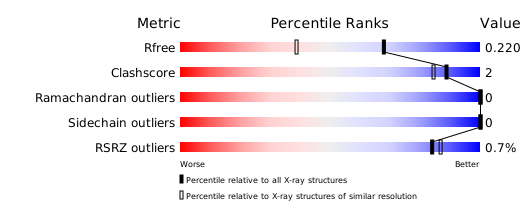
検証レポート(詳細版) をダウンロード
をダウンロード


