






 9DUQ
9DUQ
HURP(65-174) bound to GMPCPP-stabilized microtubule
9DUQ の概要
| エントリーDOI | 10.2210/pdb9duq/pdb |
| EMDBエントリー | 47173 |
| 分子名称 | Disks large-associated protein 5, Tubulin beta chain, Tubulin alpha chain, ... (6 entities in total) |
| 機能のキーワード | microtubule, nucleation, spindle, oncogene, cell cycle |
| 由来する生物種 | Homo sapiens (human) 詳細 |
| タンパク質・核酸の鎖数 | 27 |
| 化学式量合計 | 932255.22 |
| 構造登録者 | |
| 主引用文献 | Valdez, V.A.,Ma, M.,Gouveia, B.,Zhang, R.,Petry, S. HURP facilitates spindle assembly by stabilizing microtubules and working synergistically with TPX2. Nat Commun, 15:9689-9689, 2024 Cited by PubMed Abstract: In vertebrate spindles, most microtubules are formed via branching microtubule nucleation, whereby microtubules nucleate along the side of pre-existing microtubules. Hepatoma up-regulated protein (HURP) is a microtubule-associated protein that has been implicated in spindle assembly, but its mode of action is yet to be defined. In this study, we show that HURP is necessary for RanGTP-induced branching microtubule nucleation in Xenopus egg extract. Specifically, HURP stabilizes the microtubule lattice to promote microtubule formation from γ-TuRC. This function is shifted to promote branching microtubule nucleation through enhanced localization to TPX2 condensates, which form the core of the branch site on microtubules. Lastly, we provide a high-resolution cryo-EM structure of HURP on the microtubule, revealing how HURP binding stabilizes the microtubule lattice. We propose a model in which HURP stabilizes microtubules during their formation, and TPX2 preferentially enriches HURP to microtubules to promote branching microtubule nucleation and thus spindle assembly. PubMed: 39516491DOI: 10.1038/s41467-024-53630-6 主引用文献が同じPDBエントリー |
| 実験手法 | ELECTRON MICROSCOPY (2.8 Å) |
構造検証レポート
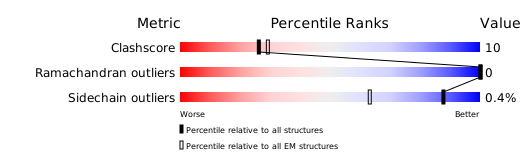
検証レポート(詳細版) をダウンロード
をダウンロード


