






 9DSN
9DSN
D306A Mutant of M.tuberculosis MenD (SEPHCHC Synthase)
9DSN の概要
| エントリーDOI | 10.2210/pdb9dsn/pdb |
| 関連するPDBエントリー | 9DQI |
| 分子名称 | 2-succinyl-5-enolpyruvyl-6-hydroxy-3-cyclohexene-1-carboxylate synthase, FORMIC ACID, THIAMINE DIPHOSPHATE, ... (7 entities in total) |
| 機能のキーワード | mycobaterium tuberculosis, menaquinone biosynthesis, mend, sephchc synthase, allosteric regulator, dhna, cooperativity, allostery mutant, biosynthetic protein |
| 由来する生物種 | Mycobacterium tuberculosis H37Rv |
| タンパク質・核酸の鎖数 | 4 |
| 化学式量合計 | 241764.94 |
| 構造登録者 | Johnston, J.M.,Ho, N.A.T.,Given, F.M.,Allison, T.A.,Bulloch, E.M.M.,Jiao, W. (登録日: 2024-09-28, 公開日: 2025-04-16, 最終更新日: 2025-04-30) |
| 主引用文献 | Ho, N.A.T.,Given, F.M.,Stanborough, T.,Klein, M.,Allison, T.M.,Bulloch, E.M.M.,Jiao, W.,Johnston, J.M. Apparent Reversal of Allosteric Response in Mycobacterium tuberculosis MenD Reveals Links to Half-of-Sites Reactivity. Chembiochem, 26:e202400943-e202400943, 2025 Cited by PubMed Abstract: Redox-active molecules play critical roles in various biological functions, including cellular respiration. In bacterial electron transport chains, menaquinones serve as key electron carriers. The first committed enzyme in the menaquinone biosynthesis pathway of Mycobacterium tuberculosis (Mtb), MenD, is allosterically inhibited by 1,4-dihydroxy-2-naphthoic acid (DHNA), the first redox-active metabolite in the pathway. Structural asymmetries in Mtb-MenD suggest that this enzyme operates via a half-of-sites mechanism for catalysis. Here, we investigate the interplay between its catalytic and allosteric mechanisms. Using molecular dynamics (MD) simulations, mutagenesis, kinetic and binding assays, and structural analyses, we identified and characterised mutants of two residues, D141 and D306, involved in stabilising asymmetric conformations associated with allostery. These mutations had complex effects on Mtb-MenD's reaction kinetics, with the D306 mutants showing an apparent reversal of the allosteric response to DHNA. Our findings indicate that asymmetric active site conformations may facilitate optimal binding of cofactors and substrates, while the transition between alternating active site conformations is essential for the catalytic cycle. DHNA binding stabilises asymmetry in the tetramer, likely promoting the binding of cofactors, substrates, or reaction intermediates. However, DHNA interferes with the transition between alternating conformations, ultimately impairing turnover and catalytic cycling in Mtb-MenD. PubMed: 39945237DOI: 10.1002/cbic.202400943 主引用文献が同じPDBエントリー |
| 実験手法 | X-RAY DIFFRACTION (2.3 Å) |
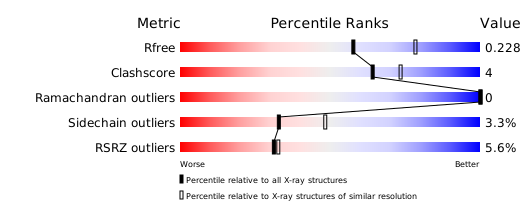
構造検証レポート
検証レポート(詳細版) をダウンロード
をダウンロード


