






 9DQQ
9DQQ
Crystal structure of HrmJ from Streptomyces sp. Ag109_G2-6 (HrmJ-ssa) complexed with ferric iron(III) and 2-oxoglutarate
9DQQ の概要
| エントリーDOI | 10.2210/pdb9dqq/pdb |
| 分子名称 | 2OG-Fe dioxygenase family protein, 2-OXOGLUTARIC ACID, FE (III) ION, ... (4 entities in total) |
| 機能のキーワード | hydroxylase, non-heme iron 2og enzyme, oxidoreductase |
| 由来する生物種 | Streptomyces sp. Ag109_G2-6 |
| タンパク質・核酸の鎖数 | 2 |
| 化学式量合計 | 59151.27 |
| 構造登録者 | |
| 主引用文献 | Zheng, Y.C.,Li, X.,Cha, L.,Paris, J.C.,Michael, C.,Ushimaru, R.,Ogasawara, Y.,Abe, I.,Guo, Y.,Chang, W.C. Comparison of a Nonheme Iron Cyclopropanase with a Homologous Hydroxylase Reveals Mechanistic Features Associated with Distinct Reaction Outcomes. J.Am.Chem.Soc., 147:6162-6170, 2025 Cited by PubMed Abstract: Despite the diversity of reactions catalyzed by mononuclear iron and 2-oxoglutarate-dependent enzymes, the factors that lead to diverse reaction outcomes beyond canonical hydroxylation remain elusive. Cyclopropanation reactions are of particular interest not only due to the prevalence of cyclopropane moieties in pharmaceuticals but also due to the chemistry that allows cyclopropanation to outcompete oxygen rebound. HrmJ is one such cyclopropanase from the biosynthetic pathway of hormaomycin; however, a homologue is herein discovered that instead catalyzes -hydroxylation of the same nitro enolate substrate. These enzymes were reconstituted with Mn(II) and V(IV)═O as mimics of the resting (Fe(II)) and reactive (Fe(IV)═O) intermediate states, respectively. Corresponding crystal structures of the cyclopropanase bound with a substrate imply H atom transfer via an offline π-pathway. In contrast, analogous structural analysis of the hydroxylase implies H atom abstraction likely proceeds through a σ-pathway. Preparation of isotopically labeled substrates and stopped-flow kinetic analyses indicate that while the hydrogen of C4 is abstracted in both enzymes, the Fe(IV)═O intermediate reacts ca. 17-fold faster in the active site of the hydroxylase, consistent with the mechanistic assignments. These results also support a correlation between the mechanism of H atom transfer and the subsequent fate of the substrate radical once generated. A subtle difference in substrate positioning not only affects the H atom abstraction pathway but also allows the nitro enolate moiety to intercept the resulting substrate radical in the active site of the cyclopropase, thereby facilitating intramolecular C-C bond formation in a stereoselective manner. PubMed: 39901767DOI: 10.1021/jacs.4c17741 主引用文献が同じPDBエントリー |
| 実験手法 | X-RAY DIFFRACTION (2.45 Å) |
構造検証レポート
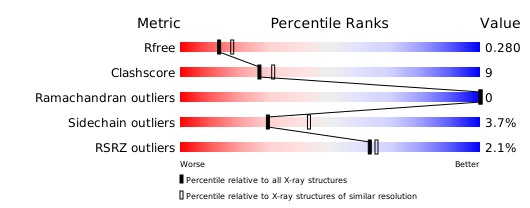
検証レポート(詳細版) をダウンロード
をダウンロード


