






 9DQD
9DQD
cryo-EM structure of human Cereblon/DDB1 in complex with a non-traditional CRBN binder
これはPDB形式変換不可エントリーです。
9DQD の概要
| エントリーDOI | 10.2210/pdb9dqd/pdb |
| EMDBエントリー | 47111 |
| 分子名称 | Protein cereblon, DNA damage-binding protein 1, ZINC ION, ... (4 entities in total) |
| 機能のキーワード | crl4, ubiquitin, e3, cereblon, ligase |
| 由来する生物種 | Homo sapiens (human) 詳細 |
| タンパク質・核酸の鎖数 | 2 |
| 化学式量合計 | 147335.88 |
| 構造登録者 | |
| 主引用文献 | Lejava, A.,Miseo, G.A.,Phan, T.,Zhu, J.,Powers, H.L.,Li, J.,Mortensen, D.S.,Zapf, C.W.,Khambatta, G.,Buenviaje, J.,Holmberg-Douglas, N. Development of a Buchwald-Hartwig Amination for an Accelerated Library Synthesis of Cereblon Binders. Acs Med.Chem.Lett., 16:89-95, 2025 Cited by PubMed Abstract: In recent years, targeted protein degradation (TPD) has emerged as a powerful therapeutic modality utilizing both heterobifunctional ligand-directed degraders (LDDs) and molecular glues (e.g., CELMoDs) to recruit E3 ligases for inducing polyubiquitination and subsequent proteasomal degradation of target proteins. The immunomodulatory drugs lenalidomide and pomalidomide bind to cereblon (CRBN), a substrate receptor of the CRL4A E3 ligase complex, to initiate degradation of neosubstrates critical for cell survival. Recently, nonlenalidomide or pomalidomide CRBN binders, known as alternate glutarimides, have gained popularity, offering potential degraders with varying physicochemical properties. Specifically, 3-substituted indazole derivatives have emerged as potent CRBN binders. We developed conditions for the direct cross-coupling of unprotected glutarimides with amines, streamlining the synthesis of alternative CRBN binders. This manuscript describes the rapid synthesis of 30 CRBN binders, their characterization as potential degraders and a cryo-EM structure of the CRBN/DDB1 with a representative compound (). PubMed: 39811117DOI: 10.1021/acsmedchemlett.4c00462 主引用文献が同じPDBエントリー |
| 実験手法 | ELECTRON MICROSCOPY (3 Å) |
構造検証レポート
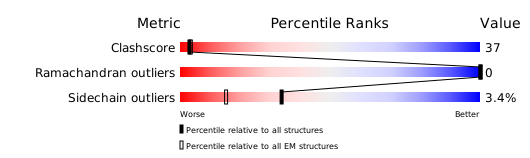
検証レポート(詳細版) をダウンロード
をダウンロード


