






9DFX
Cryo-EM structure of a SUR1/Kir6.2 ATP-sensitive potassium channel in the presence of Aekatperone in the closed conformation
これはPDB形式変換不可エントリーです。
9DFX の概要
| エントリーDOI | 10.2210/pdb9dfx/pdb |
| EMDBエントリー | 46820 |
| 分子名称 | ATP-sensitive inward rectifier potassium channel 11, SUR1, ADENOSINE-5'-TRIPHOSPHATE, ... (6 entities in total) |
| 機能のキーワード | atp-sensitive potassium channel, katp channel, sur1, kir6.2, potassium transport, metabolic sensor, congenital hyperinsulinism, trafficking, pharmacochaperone, transport protein |
| 由来する生物種 | Rattus norvegicus (Norway rat) 詳細 |
| タンパク質・核酸の鎖数 | 5 |
| 化学式量合計 | 355334.84 |
| 構造登録者 | |
| 主引用文献 | Elsheikh, A.,Driggers, C.M.,Truong, H.H.,Yang, Z.,Allen, J.,Henriksen, N.M.,Walczewska-Szewc, K.,Shyng, S.L. AI-based discovery and cryoEM structural elucidation of a K ATP channel pharmacochaperone. Elife, 13:-, 2025 Cited by PubMed Abstract: Pancreatic K channel trafficking defects underlie congenital hyperinsulinism (CHI) cases unresponsive to the K channel opener diazoxide, the mainstay medical therapy for CHI. Current clinically used K channel inhibitors have been shown to act as pharmacochaperones and restore surface expression of trafficking mutants; however, their therapeutic utility for K trafficking-impaired CHI is hindered by high affinity binding, which limits functional recovery of rescued channels. Recent structural studies of K channels employing cryo-electron microscopy (cryoEM) have revealed a promiscuous pocket where several known K pharmacochaperones bind. The structural knowledge provides a framework for discovering K channel pharmacochaperones with desired reversible inhibitory effects to permit functional recovery of rescued channels. Using an AI-based virtual screening technology AtomNet followed by functional validation, we identified a novel compound, termed Aekatperone, which exhibits chaperoning effects on K channel trafficking mutations. Aekatperone reversibly inhibits K channel activity with a half-maximal inhibitory concentration (IC) ~9 μM. Mutant channels rescued to the cell surface by Aekatperone showed functional recovery upon washout of the compound. CryoEM structure of K bound to Aekatperone revealed distinct binding features compared to known high affinity inhibitor pharmacochaperones. Our findings unveil a K pharmacochaperone enabling functional recovery of rescued channels as a promising therapeutic for CHI caused by K trafficking defects. PubMed: 40135739DOI: 10.7554/eLife.103159 主引用文献が同じPDBエントリー |
| 実験手法 | ELECTRON MICROSCOPY (4.1 Å) |
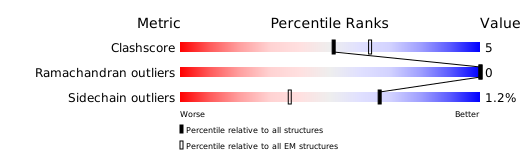
構造検証レポート
検証レポート(詳細版) をダウンロード
をダウンロード


