






 9DC0
9DC0
Crystal Structure of European Robin CRY1
9DC0 の概要
| エントリーDOI | 10.2210/pdb9dc0/pdb |
| 分子名称 | Cryptochrome-1 (2 entities in total) |
| 機能のキーワード | cryptochrome, circadian, circadian clock protein |
| 由来する生物種 | Erithacus rubecula (European robin) |
| タンパク質・核酸の鎖数 | 1 |
| 化学式量合計 | 59087.68 |
| 構造登録者 | Wickramaratne, A.,Chelliah, Y.,Green, C.B.,Takahashi, J.S.,Zoltowski, B.D. (登録日: 2024-08-24, 公開日: 2025-08-27, 最終更新日: 2026-03-18) |
| 主引用文献 | Wickramaratne, A.C.,Rasmussen, E.S.,Chelliah, Y.,Schuhmann, F.,Solov'yov, I.A.,Mouritsen, H.,Green, C.B.,Zoltowski, B.D.,Takahashi, J.S. Structure of European robin cryptochrome 1 reveals a role in circadian rhythms, not magnetoreception. Iscience, 28:114015-114015, 2025 Cited by PubMed Abstract: Cryptochromes (CRYs) play critical roles in regulating diverse physiological functions, including circadian rhythms and neuronal firing in light-dependent or -independent fashions. Structural studies of CRYs have highlighted common features, such as the photolyase homology region (PHR), but they also reveal key differences, particularly in the binding of the flavin adenine dinucleotide (FAD) cofactor, leading to a long-standing debate, namely, whether Type I CRYs can function as FAD-dependent photosensors. This study solves the first crystal structure of a Type II CRY from a migratory songbird, namely, the European robin () CRY1. Structural, biochemical, and computational analyses of erCRY1 reveal that, unlike light-activated Type I and IV CRYs, Type II CRYs do not bind FAD and employ an open primary pocket for protein-protein interactions. These findings offer new insights into the structural basis of CRY function and suggest that migratory song-bird Type II CRYs function as circadian regulators, not magnetoreceptors. PubMed: 41488359DOI: 10.1016/j.isci.2025.114015 主引用文献が同じPDBエントリー |
| 実験手法 | X-RAY DIFFRACTION (1.91 Å) |
構造検証レポート
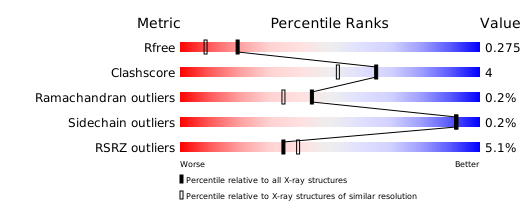
検証レポート(詳細版) をダウンロード
をダウンロード


