






 9D2F
9D2F
3D structure and atomic model of RS3 of mouse respiratory cilia
This is a non-PDB format compatible entry.
Summary for 9D2F
| Entry DOI | 10.2210/pdb9d2f/pdb |
| EMDB information | 46494 |
| Descriptor | Adenylate kinase 9, Cilia- and flagella-associated protein 43, Cilia- and flagella-associated protein 44, ... (25 entities in total) |
| Functional Keywords | axoneme, radial spoke, structural protein |
| Biological source | Mus musculus (house mouse) More |
| Total number of polymer chains | 29 |
| Total formula weight | 3090152.63 |
| Authors | Yanhe, Z.,Xuewu, Z.,Daniela, N. (deposition date: 2024-08-08, release date: 2025-08-13, Last modification date: 2026-02-25) |
| Primary citation | Zhao, Y.,Song, K.,Tavakoli, A.,Gui, L.,Fernandez-Gonzalez, A.,Zhang, S.,Dzeja, P.P.,Mitsialis, S.A.,Zhang, X.,Nicastro, D. Mouse radial spoke 3 is a metabolic and regulatory hub in cilia. Nat.Struct.Mol.Biol., 32:1542-1554, 2025 Cited by PubMed Abstract: Cilia are microtubule-based organelles that have important roles in cell sensing, signaling and motility. Recent studies have revealed the atomic structures of many multicomponent ciliary complexes, elucidating their mechanisms of action. However, little is known about the structure, proteome and function of full-length radial spoke 3 (RS3), a conserved complex that transmits mechanochemical signals to coordinate ciliary motility. Here, we combined single-particle cryo-electron microscopy, cryo-electron tomography, proteomic analysis and computational modeling to determine the three-dimensional structure and atomic model of RS3 from mouse respiratory cilia. We reveal all RS3 components, including regulatory and metabolic enzymes such as a protein kinase A subunit, adenylate kinases (AKs) and malate dehydrogenases. Furthermore, we confirm RS3 loss in AK7-deficient mice, which exhibit motility defects. Our findings identify RS3 as an important regulatory and metabolic hub that maintains sufficient adenosine triphosphate for sustained ciliary beating, providing insights into the etiology of ciliopathies. PubMed: 40579595DOI: 10.1038/s41594-025-01594-6 PDB entries with the same primary citation |
| Experimental method | ELECTRON MICROSCOPY (4.7 Å) |
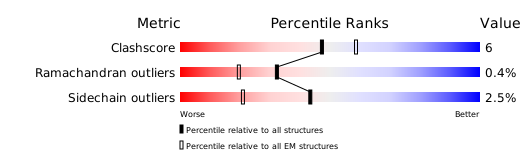
Structure validation
Download full validation report


