






 9CLE
9CLE
Importin alpha isoform 2 with synthetic zero net-charge nuclear localization signal
9CLE の概要
| エントリーDOI | 10.2210/pdb9cle/pdb |
| 関連するPDBエントリー | 9CL8 |
| 分子名称 | Importin subunit alpha-1, Zero net-charge NLS, GLYCEROL, ... (5 entities in total) |
| 機能のキーワード | nuclear transport, nuclear localization signal binding, arm repeats, protein transport |
| 由来する生物種 | Mus musculus (house mouse) 詳細 |
| タンパク質・核酸の鎖数 | 3 |
| 化学式量合計 | 58488.32 |
| 構造登録者 | Zeytuni, N.,Yang, Z.,Odeh-Ahmed, A.,Abdoli, A.,Leyton, V.J.,Bednova, O.,Lavigne, P.,Lemieux, B. (登録日: 2024-07-11, 公開日: 2025-09-03) |
| 主引用文献 | Abdoli, A.,Yang, Z.,Odeh-Ahmed, A.,Bednova, O.,Lemieux, B.,Dawe, L.,Ravel-Chapuis, A.,Lavigne, P.,Zeytuni, N.,Leyton, J.V. Probing the extent of importin-alpha targeting of the TAF8 NLS by eliminating its cationic net-charge. Protein Sci., 34:e70272-e70272, 2025 Cited by PubMed Abstract: The nucleus, as the control center of the eukaryotic cell, is a prime target for therapeutic interventions due to its role in regulating genetic material. Importin-α is critical for successful nuclear import as it recognizes and binds to cargo proteins bearing a classical nuclear localization signal (NLS), which facilitates their transport from the cytoplasm into the nucleus. NLS tagging to 'actively' import therapeutics provides the most effective means of maximizing nuclear localization and therapeutic efficacy. However, traditional NLSs are highly cationic due to the recognition and binding requirements with importin-α. Because of their highly 'super-charged' nature, NLS-tagged therapeutics face significant challenges, including poor pharmacokinetics due to non-specific interactions. In this study, we engineered novel NLS tags with zero net charge to potentially overcome this limitation. Computational modeling and experimental validation revealed that these net-neutral NLSs bind to importin-α with similar modes and energies as their cationic counterpart. High-resolution structural determination and analysis by X-ray crystallography then confirmed their binding modes. Biophysical methods using circular dichroism, microscale thermophoresis, and cellular localization studies demonstrated that these NLSs maintain sufficiently stable complexes and acceptable binding to importin-α and are functional. Additionally, this study revealed that the minor NLS-binding site of importin-α, with its extensive cationic surface area, was particularly suited for interactions with the acidic residues of the net-neutral NLSs. This study provides a foundational understanding of NLS-importin interactions and presents net-neutral NLSs as viable candidates for next-generation NLS-therapeutic development and expands the scope of nuclear-targeting therapies. PubMed: 40852899DOI: 10.1002/pro.70272 主引用文献が同じPDBエントリー |
| 実験手法 | X-RAY DIFFRACTION (2.34 Å) |
構造検証レポート
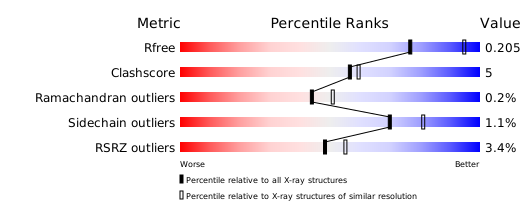
検証レポート(詳細版) をダウンロード
をダウンロード


