






 9CDX
9CDX9CDX の概要
| エントリーDOI | 10.2210/pdb9cdx/pdb |
| 分子名称 | Mitogen-activated protein kinase kinase kinase 12, (5P)-5-[(4R)-6-(propan-2-yl)imidazo[1,5-a]pyridin-1-yl]-3-(trifluoromethyl)pyridin-2-amine (3 entities in total) |
| 機能のキーワード | dual leucine zipper bearing kinase, complex, inhibitor, transferase, transferase-inhibitor complex, transferase/inhibitor |
| 由来する生物種 | Homo sapiens (human) |
| タンパク質・核酸の鎖数 | 1 |
| 化学式量合計 | 34338.34 |
| 構造登録者 | |
| 主引用文献 | Lagiakos, H.R.,Zou, Y.,Igawa, H.,Therrien, E.,Lawrenz, M.,Kato, M.,Svensson, M.,Gray, F.,Jensen, K.,Dahlgren, M.K.,Pelletier, R.D.,Dingley, K.,Bell, J.A.,Liu, Z.,Jiang, Y.,Zhou, H.,Skene, R.J.,Nie, Z. In Silico Enabled Discovery of KAI-11101, a Preclinical DLK Inhibitor for the Treatment of Neurodegenerative Disease and Neuronal Injury. J.Med.Chem., 68:2720-2741, 2025 Cited by PubMed Abstract: Dual leucine zipper kinase (DLK), expressed primarily in neuronal cells, is a regulator of neuronal degeneration in response to cellular stress from chronic disease or neuronal injury. This makes it an attractive target for the treatment of neurodegenerative diseases such as Alzheimer's, Parkinson's, and amyotrophic lateral sclerosis, and neuronal injury, such as chemotherapy-induced peripheral neuropathy. Here, we describe the discovery of a potent, selective, brain-penetrant DLK inhibitor, KAI-11101 (). Throughout the program's progression, medicinal chemistry challenges such as potency, hERG inhibition, CNS penetration, CYP3A time-dependent inhibition, and kinase selectivity were overcome through the implementation of cutting-edge tools. KAI-11101 displayed an excellent safety profile and showed neuroprotective properties in an axon fragmentation assay as well as dose-dependent activity in a mouse PD model. PubMed: 39670820DOI: 10.1021/acs.jmedchem.4c02074 主引用文献が同じPDBエントリー |
| 実験手法 | X-RAY DIFFRACTION (2.38 Å) |
構造検証レポート
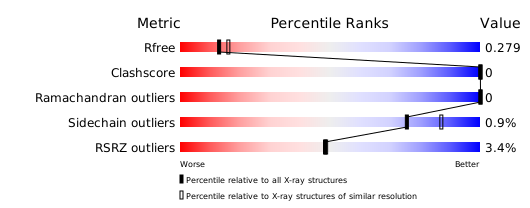
検証レポート(詳細版) をダウンロード
をダウンロード


