






9B2N
Structure of the quorum quenching lactonase GcL D122N mutant - monometal center
9B2N の概要
| エントリーDOI | 10.2210/pdb9b2n/pdb |
| 関連するPDBエントリー | 6n9i 6N9Q 6N9R 9AYT 9B2I 9B2J 9B2L |
| 分子名称 | quorum-quenching N-acyl-homoserine lactonase, COBALT (II) ION, SULFATE ION, ... (6 entities in total) |
| 機能のキーワード | quorum sensing, quorum quenching, lactonase, metalloenzyme, hydrolase |
| 由来する生物種 | Parageobacillus caldoxylosilyticus |
| タンパク質・核酸の鎖数 | 3 |
| 化学式量合計 | 104949.80 |
| 構造登録者 | Corbella, M.,Bravo, J.A.,Demkiv, A.O.,Calixto, A.R.,Sompiyachoke, K.,Bergonzi, C.,Kamerlin, S.C.L.,Elias, M. (登録日: 2024-03-15, 公開日: 2024-11-06) |
| 主引用文献 | Corbella, M.,Bravo, J.,Demkiv, A.O.,Calixto, A.R.,Sompiyachoke, K.,Bergonzi, C.,Brownless, A.R.,Elias, M.H.,Kamerlin, S.C.L. Catalytic Redundancies and Conformational Plasticity Drives Selectivity and Promiscuity in Quorum Quenching Lactonases. Jacs Au, 4:3519-3536, 2024 Cited by PubMed Abstract: Several enzymes from the metallo-β-lactamase-like family of lactonases (MLLs) degrade acyl L-homoserine lactones (AHLs). They play a role in a microbial communication system known as quorum sensing, which contributes to pathogenicity and biofilm formation. Designing quorum quenching () enzymes that can interfere with this communication allows them to be used in a range of industrial and biomedical applications. However, tailoring these enzymes for specific communication signals requires a thorough understanding of their mechanisms and the physicochemical properties that determine their substrate specificities. We present here a detailed biochemical, computational, and structural study of GcL, which is a highly proficient and thermostable MLL with broad substrate specificity. We show that GcL not only accepts a broad range of substrates but also hydrolyzes these substrates through at least two different mechanisms. Further, the preferred mechanism appears to depend on both the substrate structure and/or the nature of the residues lining the active site. We demonstrate that other lactonases, such as AiiA and AaL, show similar mechanistic promiscuity, suggesting that this is a shared feature among MLLs. Mechanistic promiscuity has been seen previously in the lactonase/paraoxonase PON1, as well as with protein tyrosine phosphatases that operate via a dual general acid mechanism. The apparent prevalence of this phenomenon is significant from both a biochemical and protein engineering perspective: in addition to optimizing for specific substrates, it may be possible to optimize for specific mechanisms, opening new doors not just for the design of novel quorum quenching enzymes but also of other mechanistically promiscuous enzymes. PubMed: 39328773DOI: 10.1021/jacsau.4c00404 主引用文献が同じPDBエントリー |
| 実験手法 | X-RAY DIFFRACTION (1.9 Å) |
構造検証レポート
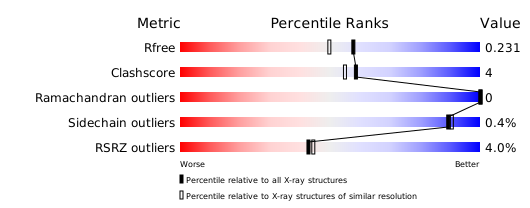
検証レポート(詳細版) をダウンロード
をダウンロード


