






 9VRF
9VRF
Fundamental structural studies of metanaphthene and introduction of disulfide bonds
This is a non-PDB format compatible entry.
Summary for 9VRF
| Entry DOI | 10.2210/pdb9vrf/pdb |
| Descriptor | Carbaryl, naphthalen-1-yl ~{N}-methylcarbamate (3 entities in total) |
| Functional Keywords | nanobody, immune system |
| Biological source | synthetic construct |
| Total number of polymer chains | 1 |
| Total formula weight | 13454.92 |
| Authors | Liang, C. (deposition date: 2025-07-06, release date: 2026-07-01, Last modification date: 2026-07-15) |
| Primary citation | Liang, C.X.,Liu, M.L.,Guo, P.Y.,Fang, R.Y.,Hendrickson, O.D.,Zherdev, A.V.,Wang, H.,Xu, Z.L.,Shen, X. An Effective Way to Introduce Disulfide Bonds into Nanobodies: Using an Anticarbaryl Nanobody Structure as a Model. J.Agric.Food Chem., 74:19995-20004, 2026 Cited by PubMed Abstract: The unique characteristics of nanobodies make them ideal candidates for diagnostic and therapeutic applications. Introducing additional disulfide bonds is one of the most effective ways to enhance a nanobody's stability. However, it always negatively affects the nanobody's affinity and expression in host cells. In this study, an anticarbaryl nanobody (NbCBR) was used as a model to investigate the strategy of additional disulfide bond introduction. The crystal structure of the NbCBR-carbaryl complex was determined, based on which molecular dynamics simulations and virtual screening were carried out. Seven disulfide bond-introduced mutants were then constructed. Compared with the wild-type nanobody, all the mutants retained good sensitivity. The results demonstrate that introducing disulfide bonds between two β-sheets or anchoring the flexible CDR3 to a β-sheet can significantly enhance the nanobody's stability under thermal, organic solvent, and pH stress conditions. This study provides a theoretical basis for rational engineering of nanobodies to improve their stability, potentially expanding their further applications. PubMed: 42328891DOI: 10.1021/acs.jafc.6c03602 PDB entries with the same primary citation |
| Experimental method | X-RAY DIFFRACTION (1.45 Å) |
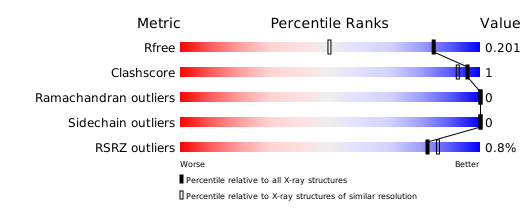
Structure validation
Download full validation report


