




 9OBE
Crystal structure of human Argonaute2 in complex with a fully modified siRNA with a 5'-phenylpropyl phosphate
This is a non-PDB format compatible entry.
Summary for 9OBE
| Entry DOI | 10.2210/pdb9obe/pdb |
| Related | 9OBD |
| Descriptor | Protein argonaute-2, fully modified siRNA with a 5' phenylpropyl phosphate, MAGNESIUM ION, ... (5 entities in total) |
| Functional Keywords | ago2, sirna, phosphorothioate, hydrolase |
| Biological source | Homo sapiens (human) More |
| Total number of polymer chains | 2 |
| Total formula weight | 104775.45 |
| Authors | Gebert, L.F.R.,MacRae, I.J. (deposition date: 2025-04-22, release date: 2026-04-29, Last modification date: 2026-11-11) |
| Primary citation | Carrigan-Broda, T.,Gebert, L.F.R.,Hildebrand, S.,Yamada, N.,Luu, E.,Caiazzi, J.,McHugh, N.,Echeverria, D.,Wagh, A.,Watts, J.K.,Khvorova, A.,MacRae, I.J.,Yamada, K. Programmable Recognition of Organyl 5'-Phosphates by Human Argonaute-2. J.Am.Chem.Soc., 148:38608-38618, 2026 Cited by PubMed Abstract: To effectuate RNA interference (RNAi), Argonaute (AGO) proteins recognize and load RNA guide strands by their requisite 5'-phosphate (5'-P). However, the structural features that govern AGO2 tolerance for chemically modified 5'-P architectures remain poorly defined, despite their importance for small interfering RNA (siRNA) drug design. Moreover, degradative enzymes also recognize 5'-P, yet few stereoelectronic features are known to differentiate AGO2 recognition from competing degradation pathways. Here, we show that AGO2 accommodates a substantially broader range of 5'-P derivatives than previously recognized, and that select 5'-P mimics can exploit novel interactions with the protein to reinforce guide anchoring. Through systematic diversification of 35 organic substituents, we interrogated structural determinants of guide anchoring and enzymatic susceptibility. Our analysis identified previously uncharacterized 5'-P mimics, including methyl and phenylpropargyl 5'-phosphates (5'-PO-Me, 5'-PO-PhPrp), phenylpropargyl 5'-phosphorothioate (5'-PS-PhPrp), and 5'-mesylphosphoramidate (5'-MsPA), that preserve efficient AGO2 loading in cells while inhibiting phosphatase-mediated degradation. We further found that 5'-exonuclease susceptibility depends strongly on canonical 5' phosphate chemistry rather than steric accessibility. Structural analysis of a 5'-PO-PhPrp guide:AGO2 complex shows that the phenylpropargyl substituent engages a π-stacking network within a cluster of aromatic side chains (Y529/F811/Y815), while extended 5'-P substituents are accommodated through rotation of the 5'-P and coordinated rearrangement of water molecules within the 5'-P binding pocket. Collectively, these findings reveal the structural basis for plasticity of guide anchoring in AGO2 and establish chemically programmable 5'-end interactions as a general strategy for modulating oligonucleotide stability and activity. PubMed: 42915549DOI: 10.1021/jacs.6c03647 PDB entries with the same primary citation |
| Experimental method | X-RAY DIFFRACTION (2.3 Å) |
Structure validation
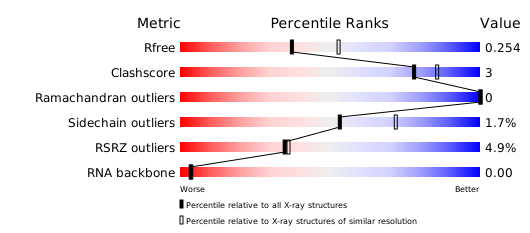
Download full validation report


