






 9GYS
9GYS
X-ray structure of the adduct formed upon reaction of RNase A with [Ru2(D-p-FPhF)(O2CCH3)2(O2CO)] complex
This is a non-PDB format compatible entry.
Summary for 9GYS
| Entry DOI | 10.2210/pdb9gys/pdb |
| Descriptor | Ribonuclease pancreatic, SULFATE ION, [Ru2-N,N'-diphenylformamidinate(O2CCH3)2(O2CO)] complex, ... (4 entities in total) |
| Functional Keywords | diruthenium, protein interaction, metallodrug, structural protein |
| Biological source | Bos taurus (domestic cattle) |
| Total number of polymer chains | 2 |
| Total formula weight | 30570.00 |
| Authors | |
| Primary citation | Ferraro, G.,Teran, A.,Galardo, F.,Lucignano, R.,Picone, D.,Massai, L.,Fasulo, F.,Munoz-Garcia, A.B.,Messori, L.,Herrero, S.,Merlino, A. Deciphering the role of neutral diruthenium complexes in protein binding. Int.J.Biol.Macromol., 283:137691-137691, 2024 Cited by PubMed Abstract: The charge of paddlewheel diruthenium complexes has a major role in defining their interaction with proteins: negatively charged complexes bind proteins non-covalently, while cationic complexes form adducts where the Ru core binds to Asp side chains at the equatorial sites, or to the main chain carbonyl groups or the side chains of His, Arg or Lys residues at the axial sites. Here we study the interactions of the neutral compound [Ru(D-p-FPhF)(OCCH)(OCO)]·3HO (D-p-FPhF = N,N'-bis(4-fluorophenyl)formamidinate), a very rare example of a paddlewheel diruthenium compound with three different equatorial ligands, with the model protein bovine pancreatic ribonuclease (RNase A) by means of UV-visible absorption spectroscopy, circular dichroism (CD), electrospray ionization mass spectrometry (ESI-MS) and X-ray crystallography. It is the first attempt to investigate the binding of a neutral diruthenium compound to a protein. ESI-MS data indicate that, in solution, under the investigated experimental conditions, the diruthenium compound binds the protein upon the loss of an acetate ligand. The crystallographic results indicate the replacement of an acetate by two water molecules and the coordination of the [Ru(D-p-FPhF)(OCCH)(OCO)(OH)] ion, that is expected to be a highly reactive species in the absence of the protein, to the imidazole ring of His105 at the axial site. The side chains of Glu9 and His119 are also identified as possible diruthenium binding sites. The binding significantly affects the protein ability to form dimers and higher-order oligomers, without significantly altering its secondary structure content and thermal stability. These data show that: i) Glu side chain has to be considered as a possible alternative binding site for diruthenium compounds, ii) diruthenium containing fragments that would be unstable in solution can be formed upon reaction of diruthenium compounds with a protein, iii) diruthenium compounds could be used as modulators of protein aggregation. PubMed: 39551297DOI: 10.1016/j.ijbiomac.2024.137691 PDB entries with the same primary citation |
| Experimental method | X-RAY DIFFRACTION (1.74 Å) |
Structure validation
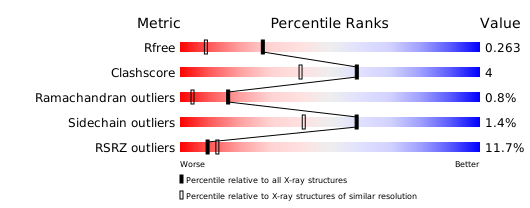
Download full validation report


