






 8ZHS
8ZHS
Structure of Mbp-Bte1 fusion protein
8ZHS の概要
| エントリーDOI | 10.2210/pdb8zhs/pdb |
| 分子名称 | Maltose/maltodextrin-binding periplasmic protein,N-terminal Bte1, C-terminal Bte1, GLYCEROL, ... (4 entities in total) |
| 機能のキーワード | antibacterial toxin, antitoxin |
| 由来する生物種 | Escherichia coli K-12 詳細 |
| タンパク質・核酸の鎖数 | 4 |
| 化学式量合計 | 138820.10 |
| 構造登録者 | |
| 主引用文献 | Lim, B.,Xu, J.,Wierzbicki, I.H.,Gonzalez, C.G.,Chen, Z.,Gonzalez, D.J.,Gao, X.,Goodman, A.L. A human gut bacterium antagonizes neighboring bacteria by altering their protein-folding ability. Cell Host Microbe, 33:200-, 2025 Cited by PubMed Abstract: Antagonistic interactions play a key role in determining microbial community dynamics. Here, we report that one of the most widespread contact-dependent effectors in human gut microbiomes, Bte1, directly targets the PpiD-YfgM periplasmic chaperone complex in related microbes. Structural, biochemical, and genetic characterization of this interaction reveals that Bte1 reverses the activity of the chaperone complex, promoting substrate aggregation and toxicity. Using Bacteroides, we show that Bte1 is active in the mammalian gut, conferring a fitness advantage to expressing strains. Recipient cells targeted by Bte1 exhibit sensitivity to membrane-compromising conditions, and human gut microbes can use this effector to exploit pathogen-induced inflammation in the gut. Further, Bte1 allelic variation in gut metagenomes provides evidence for an arms race between Bte1-encoding and immunity-encoding strains in humans. Together, these studies demonstrate that human gut microbes alter the protein-folding capacity of neighboring cells and suggest strategies for manipulating community dynamics. PubMed: 39909037DOI: 10.1016/j.chom.2025.01.008 主引用文献が同じPDBエントリー |
| 実験手法 | X-RAY DIFFRACTION (2.4 Å) |
構造検証レポート
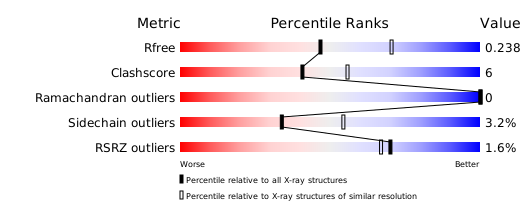
検証レポート(詳細版) をダウンロード
をダウンロード


