






8YM3
Structural basis of Elongation factor Tu in regulating photoinhibition in Synechococcus sp. PCC 7942.
Summary for 8YM3
| Entry DOI | 10.2210/pdb8ym3/pdb |
| Descriptor | Elongation factor Tu, GLYCEROL, GUANOSINE-5'-DIPHOSPHATE, ... (6 entities in total) |
| Functional Keywords | elongation factor, cyanobacteria pcc 7942, photosystem 2, photoremediation, photosynthesis |
| Biological source | Synechococcus elongatus (strain ATCC 33912 / PCC 7942 / FACHB-805) (Anacystis nidulans R2) |
| Total number of polymer chains | 1 |
| Total formula weight | 44921.03 |
| Authors | |
| Primary citation | Cheng, C.,Lu, D.,Sun, H.,Zhang, K.,Yin, L.,Luan, G.,Liu, Y.,Ma, H.,Lu, X. Structural insight into the functional regulation of Elongation factor Tu by reactive oxygen species in Synechococcus elongatus PCC 7942. Int.J.Biol.Macromol., 277:133632-133632, 2024 Cited by PubMed Abstract: In cyanobacteria, Elongation factor Tu (EF-Tu) plays a crucial role in the repair of photosystem II (PSII), which is highly susceptible to oxidative stress induced by light exposure and regulated by reactive oxygen species (ROS). However, the specific molecular mechanism governing the functional regulation of EF-Tu by ROS remains unclear. Previous research has shown that a mutated EF-Tu, where C82 is substituted with a Ser residue, can alleviate photoinhibition, highlighting the important role of C82 in EF-Tu photosensitivity. In this study, we elucidated how ROS deactivate EF-Tu by examining the crystal structures of EF-Tu in both wild-type and mutated form (C82S) individually at resolutions of 1.7 Å and 2.0 Å in Synechococcus elongatus PCC 7942 complexed with GDP. Specifically, the GDP-bound form of EF-Tu adopts an open conformation with C82 located internally, making it resistant to oxidation. Coordinated conformational changes in switches I and II create a tunnel that positions C82 for ROS interaction, revealing the vulnerability of the closed conformation of EF-Tu to oxidation. An analysis of these two structures reveals that the precise spatial arrangement of C82 plays a crucial role in modulating EF-Tu's response to ROS, serving as a regulatory element that governs photosynthetic biosynthesis. PubMed: 38971279DOI: 10.1016/j.ijbiomac.2024.133632 PDB entries with the same primary citation |
| Experimental method | X-RAY DIFFRACTION (2.05 Å) |
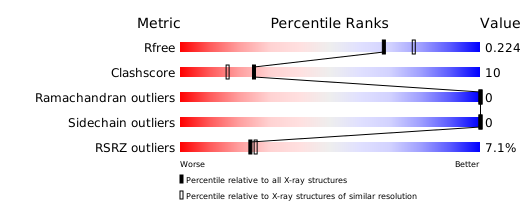
Structure validation
Download full validation report


