






 8YH0
8YH0
A3R-Gi complex bound to NECA
8YH0 の概要
| エントリーDOI | 10.2210/pdb8yh0/pdb |
| EMDBエントリー | 39278 |
| 分子名称 | HA tag,Adenosine receptor A3,LgBiT,eGFP chimera, Guanine nucleotide-binding protein G(I)/G(S)/G(O) subunit gamma-2,Guanine nucleotide-binding protein G(i) subunit alpha-1, Guanine nucleotide-binding protein G(I)/G(S)/G(T) subunit beta-1, ... (5 entities in total) |
| 機能のキーワード | gpcr, complex, adenosine receptor, adenosine, g protein, signaling protein |
| 由来する生物種 | Influenza A virus (A/Victoria/3/1975(H3N2)) 詳細 |
| タンパク質・核酸の鎖数 | 5 |
| 化学式量合計 | 254624.70 |
| 構造登録者 | |
| 主引用文献 | Oshima, H.S.,Ogawa, A.,Sano, F.K.,Akasaka, H.,Kawakami, T.,Iwama, A.,Okamoto, H.H.,Nagiri, C.,Wei, F.Y.,Shihoya, W.,Nureki, O. Structural insights into the agonist selectivity of the adenosine A 3 receptor. Nat Commun, 15:9294-9294, 2024 Cited by PubMed Abstract: Adenosine receptors play pivotal roles in physiological processes. Adenosine A receptor (AR), the most recently identified adenosine receptor, is expressed in various tissues, exhibiting important roles in neuron, heart, and immune cells, and is often overexpressed in tumors, highlighting the therapeutic potential of AR-selective agents. Recently, we identified RNA-derived N-methyladenosine (mA) as an endogenous agonist for AR, suggesting the relationship between RNA-derived modified adenosine and AR. Despite extensive studies on the other adenosine receptors, the selectivity mechanism of AR, especially for AR-selective agonists such as mA and namodenoson, remained elusive. Here, we identify tRNA-derived N-isopentenyl adenosine (iA) as an AR-selective ligand via screening of modified nucleosides against the adenosine receptors. Like mA, iA is found in the human body and may be an endogenous AR ligand. Our cryo-EM analyses elucidate the AR-G complexes bound to adenosine, 5'-N-ethylcarboxamidoadenosine (NECA), mA, iA, and namodenoson at overall resolutions of 3.27 Å (adenosine), 2.86 Å (NECA), 3.19 Å (mA), 3.28 Å (iA), and 3.20 Å (namodenoson), suggesting the selectivity and activation mechanism of AR. We further conduct structure-guided engineering of mA-insensitive AR, which may aid future research targeting mA and AR, providing a molecular basis for future drug discovery. PubMed: 39511145DOI: 10.1038/s41467-024-53473-1 主引用文献が同じPDBエントリー |
| 実験手法 | ELECTRON MICROSCOPY (2.86 Å) |
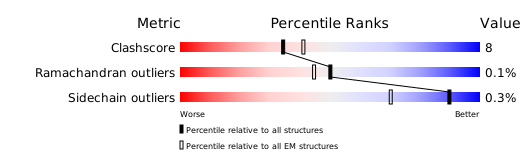
構造検証レポート
検証レポート(詳細版) をダウンロード
をダウンロード


