






 8Y9R
8Y9R
Crystal structure of Spiral2 microtubule-binding domain from Physcomitrella patens
8Y9R の概要
| エントリーDOI | 10.2210/pdb8y9r/pdb |
| 分子名称 | Microtubule binding protein (2 entities in total) |
| 機能のキーワード | structural protein, plant protein |
| 由来する生物種 | Physcomitrium patens |
| タンパク質・核酸の鎖数 | 2 |
| 化学式量合計 | 62114.01 |
| 構造登録者 | |
| 主引用文献 | Ohno, M.,Higuchi, Y.,Yamai, K.,Fuchigami, S.,Sasaki, T.,Oda, Y.,Hayashi, I. Structural analysis of microtubule binding by minus-end targeting protein Spiral2. Biochim Biophys Acta Mol Cell Res, 1871:119858-119858, 2024 Cited by PubMed Abstract: Microtubules (MTs) are dynamic cytoskeletal polymers that play a critical role in determining cell polarity and shape. In plant cells, acentrosomal MTs are localized on the cell surface and are referred to as cortical MTs. Cortical MTs nucleate in the cell cortex and detach from nucleation sites. The released MT filaments perform treadmilling, with the plus-ends of MTs polymerizing and the minus-ends depolymerizing. Minus-end targeting proteins, -TIPs, include Spiral2, which regulates the minus-end dynamics of acentrosomal MTs. Spiral2 accumulates autonomously at MT minus-ends and inhibits filament shrinkage, but the mechanism by which Spiral2 specifically recognizes minus-ends of MTs remains unknown. Here we describe the crystal structure of Spiral2's N-terminal MT-binding domain. The structural properties of this domain resemble those of the HEAT repeat structure of the tumor overexpressed gene (TOG) domain, but the number of HEAT repeats is different and the conformation is highly arched. Gel filtration and co-sedimentation analyses demonstrate that the domain binds preferentially to MT filaments rather than the tubulin dimer, and that the tubulin-binding mode of Spiral2 via the basic surface is similar to that of the TOG domain. We constructed an in silico model of the Spiral2-tubulin complex to identify residues that potentially recognize tubulin. Mutational analysis revealed that the key residues inferred in the model are involved in microtubule recognition, and provide insight into the mechanism by which end-targeting proteins stabilize MT ends. PubMed: 39370045DOI: 10.1016/j.bbamcr.2024.119858 主引用文献が同じPDBエントリー |
| 実験手法 | X-RAY DIFFRACTION (2.799 Å) |
構造検証レポート
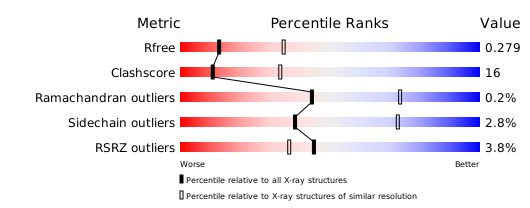
検証レポート(詳細版) をダウンロード
をダウンロード


