






 8W1M
8W1M
T.thermophilus DNAK nucleotide binding domain in complex with ADP
8W1M の概要
| エントリーDOI | 10.2210/pdb8w1m/pdb |
| 分子名称 | Chaperone protein DnaK, ADENOSINE-5'-DIPHOSPHATE, MAGNESIUM ION, ... (5 entities in total) |
| 機能のキーワード | dnak, hsp70, nucleotide binding, atpase, chaperone |
| 由来する生物種 | Thermus thermophilus |
| タンパク質・核酸の鎖数 | 2 |
| 化学式量合計 | 83616.25 |
| 構造登録者 | |
| 主引用文献 | Jiang, Y.,Ibrahim, Z.,Xia, Y.,Clay, M.,Myasnikov, A.,Immadisetty, K.,Xia, Z.,Tang, L.,Rossi, P.,Ganguly, P.,Liu, J.,Miller, D.,Che, M.,Palacios, S.M.,Kramer, G.,Bukau, B.,Kalodimos, C.G. Mechanisms of assembly and function of the Hsp70-Hsp40 chaperone machinery. Mol.Cell, 85:4032-4046.e7, 2025 Cited by PubMed Abstract: Hsp70 and Hsp40 molecular chaperones form a central machinery that remodels client proteins involved in numerous biological processes. Here, we integrated cryo-electron microscopy and nuclear magnetic resonance spectroscopy to determine the architecture of the full-length Hsp70-Hsp40 machinery. The structure of the complex in a physiologically inhibited state reveals distinct regulatory mechanisms. In the active state, the Hsp40 glycine-phenylalanine (G/F)-rich region acts as a pseudo-substrate for Hsp70, directly modulating refolding. This region also maintains Hsp40 in an autoinhibited state; upon binding to Hsp70, the inhibition is disrupted, exposing a cryptic client-binding site that enables client engagement and refolding. Transitions between these states are central to controlling refolding efficiency. Disrupting either the autoinhibited state or the G/F-Hsp70 interaction impairs function and elicits a compensatory heat shock response in cells. Our findings uncover the regulatory dynamics of a fundamental chaperone system, with broad implications for understanding protein homeostasis and the cellular response to stress. PubMed: 41092901DOI: 10.1016/j.molcel.2025.09.023 主引用文献が同じPDBエントリー |
| 実験手法 | X-RAY DIFFRACTION (2.75 Å) |
構造検証レポート
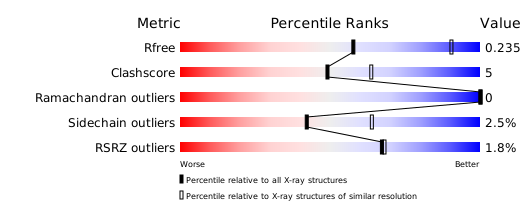
検証レポート(詳細版) をダウンロード
をダウンロード


