






 8VFT
8VFT
Translating 80S rabbit ribosome stalled by emetine with eEF2
This is a non-PDB format compatible entry.
Summary for 8VFT
| Entry DOI | 10.2210/pdb8vft/pdb |
| EMDB information | 43189 |
| Descriptor | uL2, uL5, eL13, ... (89 entities in total) |
| Functional Keywords | stalled ribosome, trnas, eef2, ribosome |
| Biological source | Oryctolagus cuniculus (rabbit) More |
| Total number of polymer chains | 85 |
| Total formula weight | 3516234.94 |
| Authors | Murray, J.,Shao, S. (deposition date: 2023-12-22, release date: 2024-12-25, Last modification date: 2026-07-01) |
| Primary citation | Zhou, C.,Zhang, M.,Murray, J.,Paulo, J.,Gygi, S.,Shao, S.,Whitman, M.,Keller, T. GCN1 couples GCN2 to ribosomal state to initiate amino acid response pathway signaling. Science, 390:eads8728-eads8728, 2025 Cited by PubMed Abstract: During nutrient deprivation, activation of the protein kinase GCN2 regulates cell survival and metabolic homeostasis. In addition to amino acid stress, GCN2 is activated by a variety of cellular stresses. GCN2 activation has been linked to its association with uncharged tRNAs, specific ribosomal proteins, and conditions of translational arrest, but their relative contribution to activation is unclear. Here, we used in vitro translation to reconstitute GCN2 activation by amino acid stress and compared collided ribosome populations induced by diverse translational stressors. Initiation of GCN2 signaling required the di-ribosome sensor GCN1, which recruits GCN2 to ribosomes in a collision-dependent manner, where GCN2 becomes activated by key ribosomal interactions and stably associated with collided ribosomes. Our findings define the molecular requirements and dynamics of GCN2 activation. PubMed: 41037622DOI: 10.1126/science.ads8728 PDB entries with the same primary citation |
| Experimental method | ELECTRON MICROSCOPY (3.3 Å) |
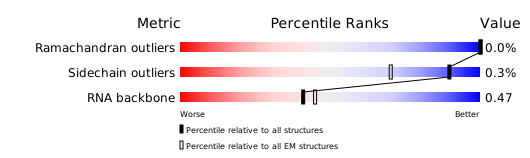
Structure validation
Download full validation report


