






 8S79
8S79
Lotus japonicus NFR5 intracellular domain in complex with Nanobody 200
8S79 の概要
| エントリーDOI | 10.2210/pdb8s79/pdb |
| 分子名称 | Nod-factor receptor 5, Nanobody 200, DI(HYDROXYETHYL)ETHER, ... (6 entities in total) |
| 機能のキーワード | receptor kinase, protein kinase, pseudokinase, nanobody, complex, plant protein |
| 由来する生物種 | Lotus japonicus 詳細 |
| タンパク質・核酸の鎖数 | 4 |
| 化学式量合計 | 93035.11 |
| 構造登録者 | |
| 主引用文献 | Hansen, S.B.,Luu, T.B.,Gysel, K.,Lironi, D.,Kronauer, C.,Rubsam, H.,Jensen, I.B.,Tsitsikli, M.,Birkefeldt, T.G.,Trgovcevic, A.,Stougaard, J.,Radutoiu, S.,Andersen, K.R. A conserved juxtamembrane motif in plant NFR5 receptors is essential for root nodule symbiosis. Proc.Natl.Acad.Sci.USA, 121:e2405671121-e2405671121, 2024 Cited by PubMed Abstract: Establishment of root nodule symbiosis is initiated by the perception of bacterial Nod factor ligands by the plant LysM receptor kinases NFR1 and NFR5. Receptor signaling initiating the symbiotic pathway depends on the kinase activity of NFR1, while the signaling mechanism of the catalytically inactive NFR5 pseudokinase is unknown. Here, we present the crystal structure of the signaling-competent NFR5 intracellular domain, comprising the juxtamembrane region and pseudokinase domain. The juxtamembrane region is structurally well defined and forms two α-helices, αA and αA', which contain an exposed hydrophobic motif. We demonstrate that this "juxtamembrane motif" promotes NFR5-NFR5 and NFR1-NFR5 interactions and is essential for symbiotic signaling. Conservation analysis reveals that the juxtamembrane motif is present throughout NFR5-type receptors and is required for symbiosis signaling from barley RLK10, suggesting a conserved and broader function for this motif in plant-microbe symbioses. PubMed: 39495923DOI: 10.1073/pnas.2405671121 主引用文献が同じPDBエントリー |
| 実験手法 | X-RAY DIFFRACTION (2.29 Å) |
構造検証レポート
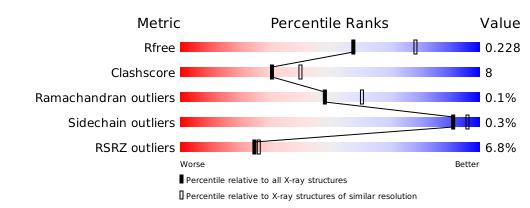
検証レポート(詳細版) をダウンロード
をダウンロード


