






 8RKP
8RKP
Cytochrome c prime from Hydrogenophilus thermoluteolus: Ferrous recombinant native with bound NO
8RKP の概要
| エントリーDOI | 10.2210/pdb8rkp/pdb |
| 関連するPDBエントリー | 5B3I |
| 分子名称 | Cytochrome c prime, NITRIC OXIDE, ASCORBIC ACID, ... (5 entities in total) |
| 機能のキーワード | nitrix oxide binding, heme protein, electron transport |
| 由来する生物種 | Hydrogenophilus thermoluteolus |
| タンパク質・核酸の鎖数 | 1 |
| 化学式量合計 | 15910.73 |
| 構造登録者 | |
| 主引用文献 | Fujii, S.,Wilson, M.T.,Adams, H.R.,Mikolajek, H.,Svistunenko, D.A.,Smyth, P.,Andrew, C.R.,Sambongi, Y.,Hough, M.A. Conformational rigidity of cytochrome c'-alpha from a thermophile is associated with slow NO binding. Biophys.J., 123:2594-2603, 2024 Cited by PubMed Abstract: Cytochromes c'-α are nitric oxide (NO)-binding heme proteins derived from bacteria that can thrive in a wide range of temperature environments. Studies of mesophilic Alcaligenes xylosoxidans cytochrome c'-α (AxCP-α) have revealed an unusual NO-binding mechanism involving both heme faces, in which NO first binds to form a distal hexa-coordinate Fe(II)-NO (6cNO) intermediate and then displaces the proximal His to form a proximal penta-coordinate Fe(II)-NO (5cNO) final product. Here, we characterize a thermally stable cytochrome c'-α from thermophilic Hydrogenophilus thermoluteolus (PhCP-α) to understand how protein thermal stability affects NO binding. Electron paramagnetic and resonance Raman spectroscopies reveal the formation of a PhCP-α 5cNO product, with time-resolved (stopped-flow) UV-vis absorbance indicating the involvement of a 6cNO intermediate. Relative to AxCP-α, the rates of 6cNO and 5cNO formation in PhCP-α are ∼11- and ∼13-fold lower, respectively. Notably, x-ray crystal structures of PhCP-α in the presence and absence of NO suggest that the sluggish formation of the proximal 5cNO product results from conformational rigidity: the Arg-132 residue (adjacent to the proximal His ligand) is held in place by a salt bridge between Arg-75 and Glu-135 (an interaction not present in AxCP-α or a psychrophilic counterpart). Overall, our data provide fresh insights into structural factors controlling NO binding in heme proteins, including 5cNO complexes relevant to eukaryotic NO sensors. PubMed: 38937973DOI: 10.1016/j.bpj.2024.06.026 主引用文献が同じPDBエントリー |
| 実験手法 | X-RAY DIFFRACTION (1.63 Å) |
構造検証レポート
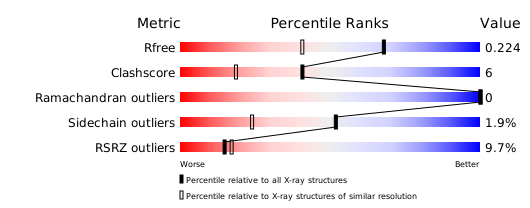
検証レポート(詳細版) をダウンロード
をダウンロード


