






 8PY2
8PY2
Cryo-EM structure of the human BRISC dimer complex bound to compound JMS-175-2
これはPDB形式変換不可エントリーです。
8PY2 の概要
| エントリーDOI | 10.2210/pdb8py2/pdb |
| 関連するPDBエントリー | 8PVY |
| EMDBエントリー | 17980 18009 |
| 分子名称 | Lys-63-specific deubiquitinase BRCC36, BRISC complex subunit Abraxas 2, BRISC and BRCA1-A complex member 2, ... (6 entities in total) |
| 機能のキーワード | brisc, brcc36, deubiquitylase, inhibitor, complex, signaling protein |
| 由来する生物種 | Homo sapiens (human) 詳細 |
| タンパク質・核酸の鎖数 | 16 |
| 化学式量合計 | 562632.87 |
| 構造登録者 | |
| 主引用文献 | Chandler, F.,Reddy, P.A.N.,Bhutda, S.,Ross, R.L.,Datta, A.,Walden, M.,Walker, K.,Di Donato, S.,Cassel, J.A.,Prakesch, M.A.,Aman, A.,Datti, A.,Campbell, L.J.,Foglizzo, M.,Bell, L.,Stein, D.N.,Ault, J.R.,Al-Awar, R.S.,Calabrese, A.N.,Sicheri, F.,Del Galdo, F.,Salvino, J.M.,Greenberg, R.A.,Zeqiraj, E. Molecular glues that inhibit deubiquitylase activity and inflammatory signaling. Nat.Struct.Mol.Biol., 2025 Cited by PubMed Abstract: Deubiquitylases (DUBs) are crucial in cell signaling and are often regulated by interactions within protein complexes. The BRCC36 isopeptidase complex (BRISC) regulates inflammatory signaling by cleaving K63-linked polyubiquitin chains on type I interferon receptors (IFNAR1). As a Zn-dependent JAMM/MPN (JAB1, MOV34, MPR1, Pad1 N-terminal) DUB, BRCC36 is challenging to target with selective inhibitors. Here, we discover first-in-class inhibitors, termed BRISC molecular glues (BLUEs), which stabilize a 16-subunit human BRISC dimer in an autoinhibited conformation, blocking active sites and interactions with the targeting subunit, serine hydroxymethyltransferase 2. This unique mode of action results in selective inhibition of BRISC over related complexes with the same catalytic subunit, splice variants and other JAMM/MPN DUBs. BLUE treatment reduced interferon-stimulated gene expression in cells containing wild-type BRISC and this effect was abolished when using structure-guided, inhibitor-resistant BRISC mutants. Additionally, BLUEs increase IFNAR1 ubiquitylation and decrease IFNAR1 surface levels, offering a potential strategy to mitigate type I interferon-mediated diseases. Our approach also provides a template for designing selective inhibitors of large protein complexes by promoting rather than blocking protein-protein interactions. PubMed: 40097626DOI: 10.1038/s41594-025-01517-5 主引用文献が同じPDBエントリー |
| 実験手法 | ELECTRON MICROSCOPY (3.32 Å) |
構造検証レポート
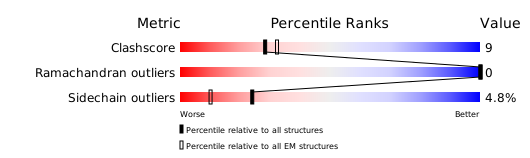
検証レポート(詳細版) をダウンロード
をダウンロード


