






8PPX
Influenza A/California/07/2009(H1N1) endonuclease in complex with flavonoid-like compound
Summary for 8PPX
| Entry DOI | 10.2210/pdb8ppx/pdb |
| Descriptor | Polymerase acidic protein, MANGANESE (II) ION, MAGNESIUM ION, ... (6 entities in total) |
| Functional Keywords | rna-dependent rna polymerase, endonuclease inhibitor, flavonoids, antivirals, viral protein |
| Biological source | Influenza A virus (A/California/07/2009(H1N1)) More |
| Total number of polymer chains | 1 |
| Total formula weight | 22041.51 |
| Authors | Radilova, K.,Brynda, J. (deposition date: 2023-07-10, release date: 2025-01-15, Last modification date: 2025-07-02) |
| Primary citation | Reiberger, R.,Kral, M.,Radilova, K.,Kotacka, T.,Dracinsky, M.,Tsalyy, A.,Brynda, J.,Majer, P.,Konvalinka, J.,Kozisek, M.,Machara, A. Beyond natural flavonoids: exploring bioisosterism in design and synthesis of influenza endonuclease inhibitors. Rsc Med Chem, 2025 Cited by PubMed Abstract: Influenza virus, an RNA virus of the family, is responsible for widespread seasonal epidemics that result in 3 to 5 million severe illnesses and more than half a million deaths annually. Given the persistent circulation of pandemic influenza variants and increasing resistance to available inhibitors, there is an urgent need for new antiviral drugs effective against various viral subtypes. Viral RNA-dependent RNA polymerase, essential for viral replication, has emerged as a promising drug target. The PA subunit with endonuclease function is especially interesting, as development of the highly potent baloxavir marboxil (Xofluza) validated its importance as a novel drug target. Flavonoids have long been studied for their anti-influenza activity but have only recently been recognized as endonuclease inhibitors. We previously identified luteolin and its glucoside derivate, orientin, as potent endonuclease inhibitors, with their binding illustrated by X-ray crystallography structures. Building on this, we employed a scaffold-hopping approach based on the luteolin structure to design structurally distinct compounds that resemble the flavonoid scaffold. Using an AlphaScreen binding assay, we identified 33 as a submicromolar PA inhibitor with low toxicity. We solved the crystal structure of the PA endonuclease-binding pseudoflavonoid 36, which has similar structure and inhibitory potency to 33. Furthermore, we identified 24, 33, 34 and 36 as inhibitors of influenza polymerase in a minireplicon luciferase reporter assay as well as inhibitors of live H1N1 virus infection in A549 human lung cells. PubMed: 40510903DOI: 10.1039/d5md00071h PDB entries with the same primary citation |
| Experimental method | X-RAY DIFFRACTION (2.5 Å) |
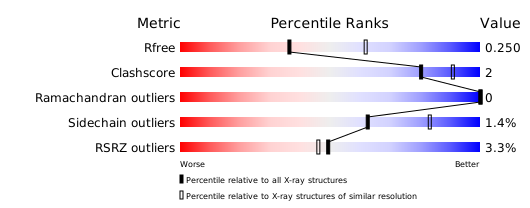
Structure validation
Download full validation report


