






8C4D
N-acetylmuramoyl-L-alanine amidase from Enterococcus faecium prophage genome
8C4D の概要
| エントリーDOI | 10.2210/pdb8c4d/pdb |
| 分子名称 | N-acetylmuramoyl-L-alanine amidase, CITRATE ANION, ZINC ION, ... (6 entities in total) |
| 機能のキーワード | enterococcus faecium, antibacterial, enzyme engineering, enzybiotics, antimicrobial protein |
| 由来する生物種 | Enterococcus faecium |
| タンパク質・核酸の鎖数 | 1 |
| 化学式量合計 | 37629.78 |
| 構造登録者 | |
| 主引用文献 | Premetis, G.E.,Stathi, A.,Papageorgiou, A.C.,Labrou, N.E. Structural and functional features of a broad-spectrum prophage-encoded enzybiotic from Enterococcus faecium. Sci Rep, 13:7450-7450, 2023 Cited by PubMed Abstract: Multidrug-resistant (MDR) bacteria have become a growing threat to public health. The gram-positive Enterococcus faecium is classified by WHO as a high-priority pathogen among the global priority list of antibiotic-resistant bacteria. Peptidoglycan-degrading enzymes (PDEs), also known as enzybiotics, are useful bactericidal agents in the fight against resistant bacteria. In this work, a genome-based screening approach of the genome of E. faecium allowed the identification of a putative PDE gene with predictive amidase activity (EfAmi1; EC 3.5.1.28) in a prophage-integrated sequence. EfAmi1 is composed by two domains: a N-terminal Zn-dependent N-acetylmuramoyl-L-alanine amidase-2 (NALAA-2) domain and a C-terminal domain with unknown structure and function. The full-length gene of EfAmi1 was cloned and expressed as a 6xHis-tagged protein in E. coli. EfAmi1 was produced as a soluble protein, purified, and its lytic and antimicrobial activities were investigated using turbidity reduction and Kirby-Bauer disk-diffusion assays against clinically isolated bacterial pathogens. The crystal structure of the N-terminal amidase-2 domain was determined using X-ray crystallography at 1.97 Å resolution. It adopts a globular fold with several α-helices surrounding a central five-stranded β-sheet. Sequence comparison revealed a cluster of conserved amino acids that defines a putative binding site for a buried zinc ion. The results of the present study suggest that EfAmi1 displays high lytic and antimicrobial activity and may represent a promising new antimicrobial in the post-antibiotic era. PubMed: 37156923DOI: 10.1038/s41598-023-34309-2 主引用文献が同じPDBエントリー |
| 実験手法 | X-RAY DIFFRACTION (1.97 Å) |
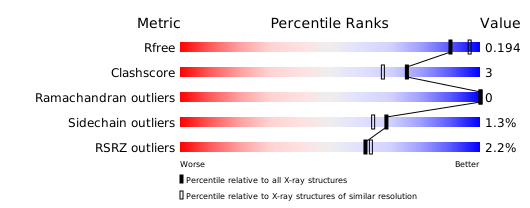
構造検証レポート
検証レポート(詳細版) をダウンロード
をダウンロード


