






 9GMQ
9GMQSummary for 9GMQ
| Entry DOI | 10.2210/pdb9gmq/pdb |
| Descriptor | 3C-like proteinase nsp5, ~{tert}-butyl ~{N}-[1-[(2~{S})-1-[[(2~{S},3~{R})-4-azanyl-3-oxidanyl-4-oxidanylidene-1-[(3~{S})-2-oxidanylidenepyrrolidin-3-yl]butan-2-yl]amino]-3-cyclopropyl-1-oxidanylidene-propan-2-yl]-2-oxidanylidene-pyridin-3-yl]carbamate, CHLORIDE ION, ... (4 entities in total) |
| Functional Keywords | inhibitor, complex, antiviral protein |
| Biological source | Severe acute respiratory syndrome coronavirus 2 |
| Total number of polymer chains | 2 |
| Total formula weight | 68697.67 |
| Authors | El Kilani, H.,Hilgenfeld, R. (deposition date: 2024-08-29, release date: 2025-01-29, Last modification date: 2026-09-02) |
| Primary citation | Akrani, I.,El Kilani, H.,Touret, F.,Kouvali, S.,Gourni, V.,Tsoka, A.,Tsetis, J.K.,Vorgias, C.,Hilgenfeld, R.,Kostakis, I.K.,Myrianthopoulos, V.,Mikros, E. Investigating the Binding Mode of a Naphthol-Based Inhibitor Targeting SARS-CoV-2 Main Protease. Chemmedchem, 21:e70448-e70448, 2026 Cited by PubMed Abstract: Regardless of the massive global efforts to combat the virus causing SARS-CoV-2 syndrome, the infection remains a substantial health challenge worldwide in the years following 2019. To this direction, targeting the main viral protease M has been proposed as a tractable and particularly promising approach toward developing effective and safe COVID-19 antivirals. By applying an integrated workflow combining a previously developed in silico consensus ranking protocol with two orthogonal in vitro methods, the NCI/DTP repository is screened and the discovery of an original naphthol scaffold with M inhibitory properties is reported. The hit is characterized in terms of structure and binding thermodynamics by combining X-ray crystallography and isothermal titration calorimetry where a binding affinity constant of 1.55 μM is determined. The compound is further evaluated against virus-infected cells, where an EC value of 7.23 μM and comparable toxicity with nirmatrelvir are measured. Chemical synthesis is additionally employed to facilitate optimal exploration of the structure-activity relationship landscape regarding the new hit. By integrating computational, biophysical, and enzymatic methods, the suggested approach allows the combination of a structural hypothesis with functional evidence and shows its capacity toward identifying and rationally optimizing structurally original noncovalent M inhibitors. PubMed: 42647061DOI: 10.1002/cmdc.70448 PDB entries with the same primary citation |
| Experimental method | X-RAY DIFFRACTION (2.19 Å) |
Structure validation
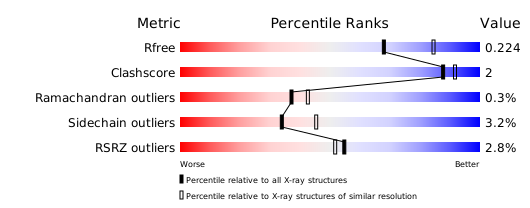
Download full validation report


