






 7KQ0
7KQ0
PCNA bound to peptide mimetic
7KQ0 の概要
| エントリーDOI | 10.2210/pdb7kq0/pdb |
| 分子名称 | Proliferating cell nuclear antigen, LYS-ARG-ARG-GLN-THR-SER-MET-THR-ASP-TYR-TYR-HIS-SER-LYS-ARG (3 entities in total) |
| 機能のキーワード | pcna, dna replication, peptide mimetic, replication |
| 由来する生物種 | Homo sapiens (Human) 詳細 |
| タンパク質・核酸の鎖数 | 6 |
| 化学式量合計 | 91844.54 |
| 構造登録者 | |
| 主引用文献 | Horsfall, A.J.,Vandborg, B.A.,Kowalczyk, W.,Chav, T.,Scanlon, D.B.,Abell, A.D.,Bruning, J.B. Unlocking the PIP-box: A peptide library reveals interactions that drive high-affinity binding to human PCNA. J.Biol.Chem., 296:100773-100773, 2021 Cited by PubMed Abstract: The human sliding clamp, Proliferating Cell Nuclear Antigen (hPCNA), interacts with over 200 proteins through a conserved binding motif, the PIP-box, to orchestrate DNA replication and repair. It is not clear how changes to the features of a PIP-box modulate protein binding and thus how they fine-tune downstream processes. Here, we present a systematic study of each position within the PIP-box to reveal how hPCNA-interacting peptides bind with drastically varied affinities. We synthesized a series of 27 peptides derived from the native protein p21 with small PIP-box modifications and another series of 19 peptides containing PIP-box binding motifs from other proteins. The hPCNA-binding affinity of all peptides, characterized as K values determined by surface plasmon resonance, spanned a 4000-fold range, from 1.83 nM to 7.59 μM. The hPCNA-bound peptide structures determined by X-ray crystallography and modeled computationally revealed intermolecular and intramolecular interaction networks that correlate with high hPCNA affinity. These data informed rational design of three new PIP-box sequences, testing of which revealed the highest affinity hPCNA-binding partner to date, with a K value of 1.12 nM, from a peptide with PIP-box QTRITEYF. This work showcases the sequence-specific nuances within the PIP-box that are responsible for high-affinity hPCNA binding, which underpins our understanding of how nature tunes hPCNA affinity to regulate DNA replication and repair processes. In addition, these insights will be useful to future design of hPCNA inhibitors. PubMed: 33984330DOI: 10.1016/j.jbc.2021.100773 主引用文献が同じPDBエントリー |
| 実験手法 | X-RAY DIFFRACTION (2.4 Å) |
構造検証レポート
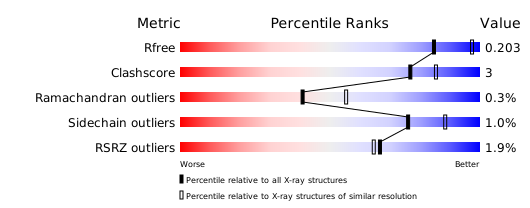
検証レポート(詳細版) をダウンロード
をダウンロード


