






 6FZ2
6FZ2
Human N-myristoyltransferase (NMT1) with Myristoyl-CoA and inhibitor bound
6FZ2 の概要
| エントリーDOI | 10.2210/pdb6fz2/pdb |
| 関連するPDBエントリー | 3IU1 3IU2 3IWE 4C2Z 4UFV |
| 分子名称 | Glycylpeptide N-tetradecanoyltransferase 1, N-[2-(3-methoxyphenyl)ethanimidoyl]-2-piperidin-4-yloxy-benzamide, TETRADECANOYL-COA, ... (6 entities in total) |
| 機能のキーワード | protein-ligand complex, transferase |
| 由来する生物種 | Homo sapiens (Human) |
| タンパク質・核酸の鎖数 | 2 |
| 化学式量合計 | 96755.17 |
| 構造登録者 | |
| 主引用文献 | Kersten, C.,Fleischer, E.,Kehrein, J.,Borek, C.,Jaenicke, E.,Sotriffer, C.,Brenk, R. How To Design Selective Ligands for Highly Conserved Binding Sites: A Case Study UsingN-Myristoyltransferases as a Model System. J.Med.Chem., 63:2095-2113, 2020 Cited by PubMed Abstract: A model system of two related enzymes with conserved binding sites, namely -myristoyltransferase from two different organisms, was studied to decipher the driving forces that lead to selective inhibition in such cases. Using a combination of computational and experimental tools, two different selectivity-determining features were identified. For some ligands, a change in side-chain flexibility appears to be responsible for selective inhibition. Remarkably, this was observed for residues orienting their side chains away from the ligands. For other ligands, selectivity is caused by interfering with a water molecule that binds more strongly to the off-target than to the target. On the basis of this finding, a virtual screen for selective compounds was conducted, resulting in three hit compounds with the desired selectivity profile. This study delivers a guideline on how to assess selectivity-determining features in proteins with conserved binding sites and to translate this knowledge into the design of selective inhibitors. PubMed: 31423787DOI: 10.1021/acs.jmedchem.9b00586 主引用文献が同じPDBエントリー |
| 実験手法 | X-RAY DIFFRACTION (2.05 Å) |
構造検証レポート
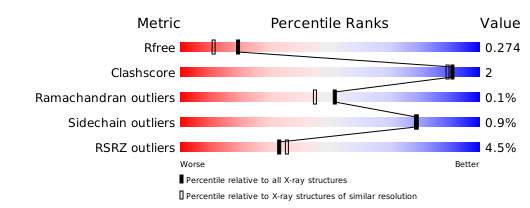
検証レポート(詳細版) をダウンロード
をダウンロード


