






 5T3A
5T3A
Maedi-Visna virus (MVV) integrase CCD-CTD (residues 60-275)
5T3A の概要
| エントリーDOI | 10.2210/pdb5t3a/pdb |
| 分子名称 | integrase, ACETATE ION, 2-(N-MORPHOLINO)-ETHANESULFONIC ACID, ... (4 entities in total) |
| 機能のキーワード | visna virus integrase, catalytic core domain, c-terminal domain, hydrolase |
| 由来する生物種 | Visna/maedi virus (MVV) |
| タンパク質・核酸の鎖数 | 1 |
| 化学式量合計 | 25979.67 |
| 構造登録者 | |
| 主引用文献 | Ballandras-Colas, A.,Maskell, D.P.,Serrao, E.,Locke, J.,Swuec, P.,Jonsson, S.R.,Kotecha, A.,Cook, N.J.,Pye, V.E.,Taylor, I.A.,Andresdottir, V.,Engelman, A.N.,Costa, A.,Cherepanov, P. A supramolecular assembly mediates lentiviral DNA integration. Science, 355:93-95, 2017 Cited by PubMed Abstract: Retroviral integrase (IN) functions within the intasome nucleoprotein complex to catalyze insertion of viral DNA into cellular chromatin. Using cryo-electron microscopy, we now visualize the functional maedi-visna lentivirus intasome at 4.9 angstrom resolution. The intasome comprises a homo-hexadecamer of IN with a tetramer-of-tetramers architecture featuring eight structurally distinct types of IN protomers supporting two catalytically competent subunits. The conserved intasomal core, previously observed in simpler retroviral systems, is formed between two IN tetramers, with a pair of C-terminal domains from flanking tetramers completing the synaptic interface. Our results explain how HIV-1 IN, which self-associates into higher-order multimers, can form a functional intasome, reconcile the bulk of early HIV-1 IN biochemical and structural data, and provide a lentiviral platform for design of HIV-1 IN inhibitors. PubMed: 28059770DOI: 10.1126/science.aah7002 主引用文献が同じPDBエントリー |
| 実験手法 | X-RAY DIFFRACTION (2.501 Å) |
構造検証レポート
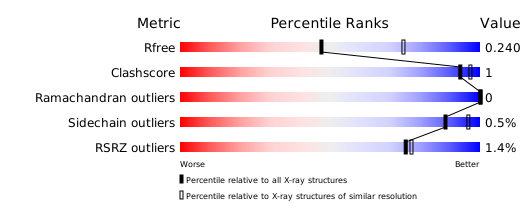
検証レポート(詳細版) をダウンロード
をダウンロード


