






 4D1Q
4D1Q
Hermes transposase bound to its terminal inverted repeat
4D1Q の概要
| エントリーDOI | 10.2210/pdb4d1q/pdb |
| 分子名称 | TRANSPOSASE, TERMINAL INVERTED REPEAT, SODIUM ION, ... (4 entities in total) |
| 機能のキーワード | transposition, protein-dna complex, tranpososome, hat |
| 由来する生物種 | MUSCA DOMESTICA (HOUSE FLY) 詳細 |
| タンパク質・核酸の鎖数 | 12 |
| 化学式量合計 | 283377.39 |
| 構造登録者 | Hickman, A.B.,Ewis, H.,Li, X.,Knapp, J.,Laver, T.,Doss, A.L.,Tolun, G.,Steven, A.,Grishaev, A.,Bax, A.,Atkinson, P.,Craig, N.L.,Dyda, F. (登録日: 2014-05-04, 公開日: 2014-07-30, 最終更新日: 2024-05-08) |
| 主引用文献 | Hickman, A.B.,Ewis, H.E.,Li, X.,Knapp, J.A.,Laver, T.,Doss, A.,Tolun, G.,Steven, A.C.,Grishaev, A.,Bax, A.,Atkinson, P.W.,Craig, N.L.,Dyda, F. Structural Basis of Hat Transposon End Recognition by Hermes, an Octameric DNA Transposase from Musca Domestica. Cell(Cambridge,Mass.), 158:353-, 2014 Cited by PubMed Abstract: Hermes is a member of the hAT transposon superfamily that has active representatives, including McClintock's archetypal Ac mobile genetic element, in many eukaryotic species. The crystal structure of the Hermes transposase-DNA complex reveals that Hermes forms an octameric ring organized as a tetramer of dimers. Although isolated dimers are active in vitro for all the chemical steps of transposition, only octamers are active in vivo. The octamer can provide not only multiple specific DNA-binding domains to recognize repeated subterminal sequences within the transposon ends, which are important for activity, but also multiple nonspecific DNA binding surfaces for target capture. The unusual assembly explains the basis of bipartite DNA recognition at hAT transposon ends, provides a rationale for transposon end asymmetry, and suggests how the avidity provided by multiple sites of interaction could allow a transposase to locate its transposon ends amidst a sea of chromosomal DNA. PubMed: 25036632DOI: 10.1016/J.CELL.2014.05.037 主引用文献が同じPDBエントリー |
| 実験手法 | X-RAY DIFFRACTION (3.4 Å) |
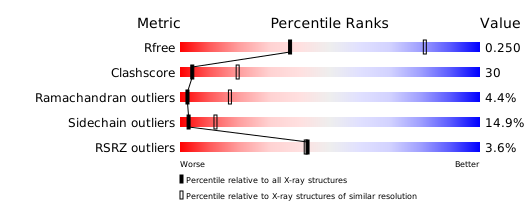
構造検証レポート
検証レポート(詳細版) をダウンロード
をダウンロード


