






 3RD2
3RD2
NIP45 SUMO-like Domain 2
3RD2 の概要
| エントリーDOI | 10.2210/pdb3rd2/pdb |
| 分子名称 | NFATC2-interacting protein (2 entities in total) |
| 機能のキーワード | sumo-like domain 2, protein:protein interaction, ubc9, transcription |
| 由来する生物種 | Homo sapiens (human) |
| 細胞内の位置 | Nucleus (By similarity): Q8NCF5 |
| タンパク質・核酸の鎖数 | 1 |
| 化学式量合計 | 9366.60 |
| 構造登録者 | |
| 主引用文献 | Prudden, J.,Perry, J.J.,Nie, M.,Vashisht, A.A.,Arvai, A.S.,Hitomi, C.,Guenther, G.,Wohlschlegel, J.A.,Tainer, J.A.,Boddy, M.N. DNA repair and global sumoylation are regulated by distinct Ubc9 noncovalent complexes. Mol.Cell.Biol., 31:2299-2310, 2011 Cited by PubMed Abstract: Global sumoylation, SUMO chain formation, and genome stabilization are all outputs generated by a limited repertoire of enzymes. Mechanisms driving selectivity for each of these processes are largely uncharacterized. Here, through crystallographic analyses we show that the SUMO E2 Ubc9 forms a noncovalent complex with a SUMO-like domain of Rad60 (SLD2). Ubc9:SLD2 and Ubc9:SUMO noncovalent complexes are structurally analogous, suggesting that differential recruitment of Ubc9 by SUMO or Rad60 provides a novel means for such selectivity. Indeed, deconvoluting Ubc9 function by disrupting either the Ubc9:SLD2 or Ubc9:SUMO noncovalent complex reveals distinct roles in facilitating sumoylation. Ubc9:SLD2 acts in the Nse2 SUMO E3 ligase-dependent pathway for DNA repair, whereas Ubc9:SUMO instead promotes global sumoylation and chain formation, via the Pli1 E3 SUMO ligase. Moreover, this Pli1-dependent SUMO chain formation causes the genome instability phenotypes of SUMO-targeted ubiquitin ligase (STUbL) mutants. Overall, we determine that, unexpectedly, Ubc9 noncovalent partner choice dictates the role of sumoylation in distinct cellular pathways. PubMed: 21444718DOI: 10.1128/MCB.05188-11 主引用文献が同じPDBエントリー |
| 実験手法 | X-RAY DIFFRACTION (1.6 Å) |
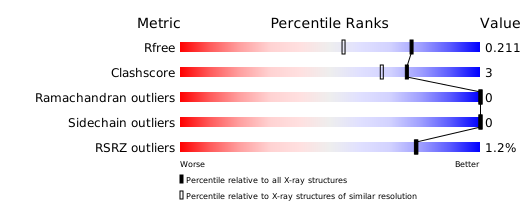
構造検証レポート
検証レポート(詳細版) をダウンロード
をダウンロード


