






 36CD
36CD
Crystal structure of CAT2
Summary for 36CD
| Entry DOI | 10.2210/pdb36cd/pdb |
| Related | 36BZ |
| Descriptor | CAT2 (1 entity in total) |
| Functional Keywords | transcription repressor, biosensor, monoterpene indole alkaloid (mia) binding protein, ramr, transcription |
| Biological source | Salmonella enterica subsp. enterica serovar Typhimurium |
| Total number of polymer chains | 2 |
| Total formula weight | 43677.98 |
| Authors | |
| Primary citation | Holtz, M.,d'Oelsnitz, S.,Domingo, C.C.,Madsen, N.G.,Hong, M.Y.,Arnesen, J.A.,van Aalst, A.C.A.,de Haan, S.,Weingarten, C.K.,Welner, D.H.,Silver, P.A.,Zhang, Y.J.,Jensen, M.K.,Acevedo-Rocha, C.G. Engineering Biosensors to Enhance Monoterpene Indole Alkaloid Production in Yeast. Biorxiv, 2026 Cited by PubMed Abstract: Monoterpene Indole Alkaloids (MIAs) are a diverse family of plant natural products with various medicinal applications. Although MIAs, such as vinblastine and reserpine, are clinically validated, sourcing of MIAs for clinical use or drug discovery from natural resources or via chemical synthesis is hampered due to their scarcity and chemical complexity. Refactoring MIA biosynthesis pathways in microbial cell factories could offer an alternative, more stable and potentially sustainable manufacturing route for alkaloid medicines and novel therapies. However, reaching commercially attractive titers, rates and yields remains challenging owing to the length and complexity of these metabolic pathways. One critical bottleneck is the low screening throughput and very high cost of the analytical methods used to quantify MIA for optimizing production. In this study, we evolved RamR, a promiscuous bacterial transcription factor to respond to five different MIAs, resulting in highly sensitive and selective sensor variants (EC50<10 μM). X-ray crystallography and computational modeling provided insight into the MIA binding of the evolved biosensor variants. The RamR biosensing platform was functionalized in yeast and subsequently applied in a cost-effective semi-throughput screening campaign of a 188-gene overexpression library to identify high-performing cell factory designs for strictosidine, the common precursor for all MIAs. The fluorescent biosensor signal correlated with HPLC quantification (r2 = 0.932) allowing identification of single metabolic engineering hits which when combined yielded a maximum titer of >220 mg/L strictosidine, 3-fold higher than the parental reference strain. This study demonstrates the development of selective biosensors for MIAs and the cost-effective identification of novel metabolic engineering hits for optimizing MIA production in microbial cell factories. PubMed: 42282776DOI: 10.64898/2026.06.01.729246 PDB entries with the same primary citation |
| Experimental method | X-RAY DIFFRACTION (2.43 Å) |
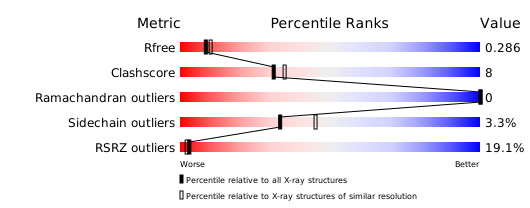
Structure validation
Download full validation report


