






 2WCD
2WCD
Crystal structure of the assembled cytolysin A pore
2WCD の概要
| エントリーDOI | 10.2210/pdb2wcd/pdb |
| 関連するPDBエントリー | 1QOY |
| 分子名称 | HEMOLYSIN E, CHROMOSOMAL, ETHYL MERCURY ION (2 entities in total) |
| 機能のキーワード | cytolytic protein, pore-forming toxin, transmembrane pore, toxin, membrane, secreted, cytolysis, periplasm, hemolysis, transmembrane, disulfide bond |
| 由来する生物種 | ESCHERICHIA COLI |
| 細胞内の位置 | Secreted: P77335 |
| タンパク質・核酸の鎖数 | 24 |
| 化学式量合計 | 842006.28 |
| 構造登録者 | Mueller, M.,Grauschopf, U.,Maier, T.,Glockshuber, R.,Ban, N. (登録日: 2009-03-11, 公開日: 2009-05-05, 最終更新日: 2024-05-08) |
| 主引用文献 | Mueller, M.,Grauschopf, U.,Maier, T.,Glockshuber, R.,Ban, N. The Structure of a Cytolytic Alpha-Helical Toxin Pore Reveals its Assembly Mechanism Nature, 459:726-, 2009 Cited by PubMed Abstract: Pore-forming toxins (PFTs) are a class of potent virulence factors that convert from a soluble form to a membrane-integrated pore. They exhibit their toxic effect either by destruction of the membrane permeability barrier or by delivery of toxic components through the pores. Among the group of bacterial PFTs are some of the most dangerous toxins, such as diphtheria and anthrax toxin. Examples of eukaryotic PFTs are perforin and the membrane-attack complex, proteins of the immune system. PFTs can be subdivided into two classes, alpha-PFTs and beta-PFTs, depending on the suspected mode of membrane integration, either by alpha-helical or beta-sheet elements. The only high-resolution structure of a transmembrane PFT pore is available for a beta-PFT--alpha-haemolysin from Staphylococcus aureus. Cytolysin A (ClyA, also known as HlyE), an alpha-PFT, is a cytolytic -helical toxin responsible for the haemolytic phenotype of several Escherichia coli and Salmonella enterica strains. ClyA is cytotoxic towards cultured mammalian cells, induces apoptosis of macrophages and promotes tissue pervasion. Electron microscopic reconstructions demonstrated that the soluble monomer of ClyA must undergo large conformational changes to form the transmembrane pore. Here we report the 3.3 A crystal structure of the 400 kDa dodecameric transmembrane pore formed by ClyA. The tertiary structure of ClyA protomers in the pore is substantially different from that in the soluble monomer. The conversion involves more than half of all residues. It results in large rearrangements, up to 140 A, of parts of the monomer, reorganization of the hydrophobic core, and transitions of -sheets and loop regions to -helices. The large extent of interdependent conformational changes indicates a sequential mechanism for membrane insertion and pore formation. PubMed: 19421192DOI: 10.1038/NATURE08026 主引用文献が同じPDBエントリー |
| 実験手法 | X-RAY DIFFRACTION (3.29 Å) |
構造検証レポート
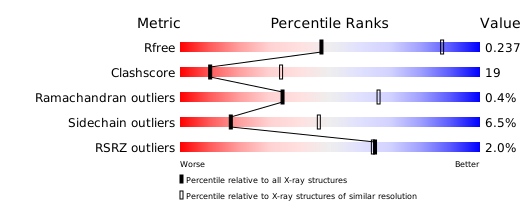
検証レポート(詳細版) をダウンロード
をダウンロード


