






21FE
Neutron crystal structure of the ADP bound form of the human Hsp90 N-terminal domain
Summary for 21FE
| Entry DOI | 10.2210/pdb21fe/pdb |
| Descriptor | Heat shock protein HSP 90-alpha, ADENOSINE-5'-DIPHOSPHATE, MAGNESIUM ION, ... (4 entities in total) |
| Functional Keywords | atp hydrolysis, protein folding, chaperone |
| Biological source | Homo sapiens (human) |
| Total number of polymer chains | 1 |
| Total formula weight | 26108.27 |
| Authors | Hirano, Y.,Kusaka, K.,Ose, T.,Kurihara, K.,Aburai, K.,Saito, J.,Tamada, T. (deposition date: 2025-12-11, release date: 2026-06-03) |
| Primary citation | Hirano, Y.,Kusaka, K.,Ose, T.,Kurihara, K.,Aburai, K.,Saito, J.I.,Tamada, T. Unperturbed hydration structure involves ADP recognition in the N-terminal domain of human heat shock protein 90 alpha. Protein Sci., 35:e70619-e70619, 2026 Cited by PubMed Abstract: Heat shock protein 90 (Hsp90) is a molecular chaperone that facilitates the folding and maturation of client proteins and is implicated in diseases such as cancer. Of its three domains-N-terminal, middle, and C-terminal-the N-terminal domain (NTD) plays a role in ATP hydrolysis, which is required for the chaperone function of Hsp90 in vivo. Precise information about ATP (and ADP) recognition is useful for designing drugs that target the ATP-binding site. X-ray crystal structures of human Hsp90α-NTD have revealed hydrogen bonds around the ADP-binding site, but the exact hydrogen-bond patterns are unclear, mainly because their structures lack the hydrogen atoms essential for identifying donor and acceptor pairs. Here, we performed neutron structural analyses of human Hsp90α-NTD in both its apo and ADP-bound forms. These structures clarify the hydrogen bonds, including the orientations of water molecules. The neutron structures show that ADP and magnesium binding do not perturb the apo state hydrogen-bond network. The orientation of a water molecule and the position of the Met98 side chain indicate that lone pair-π and CH-π interactions stabilize the binding of the adenine ring. A Hsp90-specific intramolecular hydrogen bond between the ribose moiety and the phosphate implies its contribution to the ATP hydrolysis catalyzed by Hsp90. The precise view of the ADP-binding site indicates that the unperturbed hydration structure plays an important role in ADP recognition. PubMed: 42148751DOI: 10.1002/pro.70619 PDB entries with the same primary citation |
| Experimental method | NEUTRON DIFFRACTION (2.1 Å) |
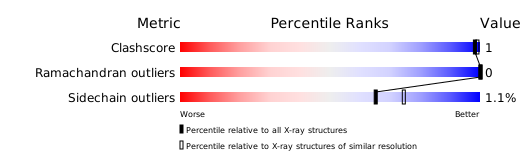
Structure validation
Download full validation report


