






 13FO
13FO
Thermotoga maritima threonylcarbamoyl transfer complex (TsaB2D) in complex with Thermotoga maritima tRNA(LYS)
Summary for 13FO
| Entry DOI | 10.2210/pdb13fo/pdb |
| EMDB information | 77048 |
| Descriptor | tRNA threonylcarbamoyladenosine biosynthesis protein TsaB, tRNA N6-adenosine threonylcarbamoyltransferase, T. maritima tRNA(LYS) (3 entities in total) |
| Functional Keywords | tsab2d2, threonylcarbamoyl transfer complex, trna, t6a, n6-threonylcarbamoyl adenosine, t6a37, transfer-rna, biosynthetic protein, biosynthetic protein-rna complex, rna binding protein, rna binding protein-rna complex, rna binding protein/rna |
| Biological source | Thermotoga maritima More |
| Total number of polymer chains | 4 |
| Total formula weight | 110053.40 |
| Authors | Kutchuashvili, A.,Swairjo, M.A. (deposition date: 2026-05-04, release date: 2026-06-17, Last modification date: 2026-06-24) |
| Primary citation | Kutchuashvili, A.,Scheleen, E.,Guynes, G.,Wu, J.,Chan, C.K.,Dedon, P.,Iwata-Reuyl, D.,Swairjo, M.A. Anticodon loop remodeling and D-stem shape drive the specific recognition of ANN-decoding tRNAs for t6A modification. Nucleic Acids Res., 54:-, 2026 Cited by PubMed Abstract: N6-threonylcarbamoyladenosine (t6A) is a universal transfer RNA (tRNA) modification essential for translational fidelity. The modification is installed at position 37 of ANN-decoding tRNAs (N is A, U, G, or C) by transfer of a threonylcarbamoyl moiety from a pathway intermediate, catalyzed in bacteria by the TsaBD complex. Despite the strict requirement for the 36-UAA-38 sequence in substrate tRNAs, the structural basis for this specificity has remained unclear. We determined cryo-EM structures of the Thermotoga maritima t6A synthase bound to unmodified and to natively modified tRNA carrying the t6A37 modification, at a nominal resolution of 3.2 Å. In both structures, A37 is positioned in the active site, and the anticodon loop is remodeled into a zig-zag conformation not previously observed in tRNA, stabilized by conserved interactions with the RNA backbone at the TsaD/TsaB interface. The wobble and middle anticodon bases occupy shallow surface pockets without base-specific contacts, explaining tolerance to base identity at these positions. In contrast, U36 and A38 are recognized indirectly through formation of a base triple with U32. Additional D-stem contacts provide a second mode of indirect readout. Together with mutagenesis data, the structures reveal the molecular basis for restriction of t6A37 to ANN-decoding tRNAs and the requirement for A38. PubMed: 42312490DOI: 10.1093/nar/gkag599 PDB entries with the same primary citation |
| Experimental method | ELECTRON MICROSCOPY (3.2 Å) |
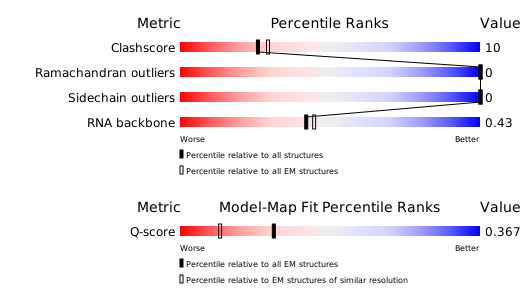
Structure validation
Download full validation report


