






 10DK
10DK
Structure of an adenovirus hexon with Zwitterionic insertion in HVR5
Summary for 10DK
| Entry DOI | 10.2210/pdb10dk/pdb |
| EMDB information | 75090 |
| Descriptor | Hexon protein (1 entity in total) |
| Functional Keywords | viral vectors, capsid engineering, zwitterionic peptides, adenoviruses, immune stealth, blood factors, neutralizing antibodies, cryo-em, virus, viral protein |
| Biological source | Human adenovirus 57 |
| Total number of polymer chains | 3 |
| Total formula weight | 313126.19 |
| Authors | |
| Primary citation | Lu, S.C.,Ma, O.X.,Anwar, A.A.,Ratkov, D.,Bhandari, J.,Montiel-Garcia, D.J.,Hansen, M.J.,Barry, M.E.,Reddy, V.S.,Barry, M.A. Immune shielding of viral vectors via capsid engineering with genetically encoded zwitterionic peptides. Mol Ther Adv, 34:201694-201694, 2026 Cited by PubMed Abstract: Pre-existing neutralizing antibodies (NAbs) and blood proteins can rapidly inactivate therapeutic viral vectors and trigger immune toxicities in patients. To overcome these challenges, we engineered the surfaces of adenovirus (Ad) by incorporating genetically encoded "protective shields" to reduce the recognition by host factors. AlphaFold3 modeling showed that inserting a structured biotin acceptor peptide (BAP) into hypervariable region 5 (HVR5) of the viral capsid protein hexon produced a rigid surface protrusion, whereas inserting a disordered, zwitterionic glutamic acid-lysine (EK) peptide formed a flexible canopy over the hexon. Although inserting EK peptides into the capsid impaired viral entry and intracellular trafficking that led to reduced viral transduction and , this modification decreased binding by coagulation factor X (FX) and complement C3. Importantly, the EK peptide-modified Ad also evaded polyclonal anti-Ad NAbs without the need to change all HVRs. The shielding efficiency of EK peptides was affected by their composition and length. Cryoelectron microscopy (cryo-EM) and neutralization assays further revealed that NAbs primarily target HVR1, a region potentially masked by EK peptides inserted in HVR5. These findings demonstrate an alternative capsid engineering approach using genetically encoded peptides to enhance immune stealth of viral vectors. PubMed: 42137280DOI: 10.1016/j.omta.2026.201694 PDB entries with the same primary citation |
| Experimental method | ELECTRON MICROSCOPY (3.22 Å) |
Structure validation
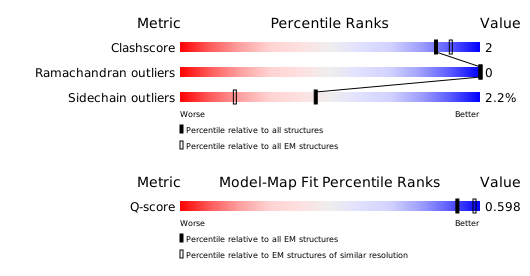
Download full validation report


