






 10AD
10AD
Cryo-EM structure of the human BK channel bound to the agonist NS1619
This is a non-PDB format compatible entry.
Summary for 10AD
| Entry DOI | 10.2210/pdb10ad/pdb |
| EMDB information | 75024 |
| Descriptor | Isoform 5 of Calcium-activated potassium channel subunit alpha-1, MAGNESIUM ION, CALCIUM ION, ... (4 entities in total) |
| Functional Keywords | bk, slo1, membrane protein |
| Biological source | Homo sapiens (human) |
| Total number of polymer chains | 4 |
| Total formula weight | 503241.66 |
| Authors | Gonzalez-Sanabria, N.,Contreras, G.F.,Perozo, E.,Latorre, R. (deposition date: 2026-01-08, release date: 2026-02-04, Last modification date: 2026-02-11) |
| Primary citation | Gonzalez-Sanabria, N.,Contreras, G.F.,Rojas, M.,Duarte, Y.,Gonzalez-Nilo, F.D.,Perozo, E.,Latorre, R. The BK channel-NS1619 agonist complex reveals molecular insights into allosteric activation gating. Proc.Natl.Acad.Sci.USA, 123:e2507707123-e2507707123, 2026 Cited by PubMed Abstract: BK channels play essential roles in a wealth of physiological functions, including regulating smooth muscle tone and neurotransmitter release. Its dysfunction, often caused by loss-of-function mutations, can lead to severe phenotypes, including ataxia and sensory impairment. Despite the therapeutic potential of BK channel agonists, the molecular mechanisms by which they stabilize the pore's open conformation remain unclear. Using cryoelectron microscopy and molecular dynamic simulations, we identified that NS1619, a synthetic benzimidazolone agonist, first described as a BK opener, binds within a pocket formed by the S6/RCK1 linker and the S4 transmembrane segment. Our simulations suggest that agonist binding promotes a twisting motion in the S6 segment, enabling critical interactions with residues K330, K331, and F223. These findings provide a molecular model for the mechanism of NS1619 and suggest that its binding site can accommodate other agonists, highlighting a promising target for therapeutic development. PubMed: 41591909DOI: 10.1073/pnas.2507707123 PDB entries with the same primary citation |
| Experimental method | ELECTRON MICROSCOPY (3.44 Å) |
Structure validation
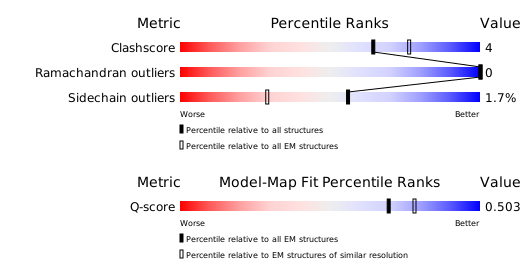
Download full validation report


