RUNX2 regulates chondrocyte maturation / response to denervation involved in regulation of muscle adaptation / negative regulation of myotube differentiation / positive regulation of cell-cell adhesion / peptidyl-lysine deacetylation / phosphorylation-dependent protein binding / positive regulation of protein sumoylation / negative regulation of transcription by competitive promoter binding / histone deacetylase activity, hydrolytic mechanism / positive regulation of T cell mediated immune response to tumor cell ...RUNX2 regulates chondrocyte maturation / response to denervation involved in regulation of muscle adaptation / negative regulation of myotube differentiation / positive regulation of cell-cell adhesion / peptidyl-lysine deacetylation / phosphorylation-dependent protein binding / positive regulation of protein sumoylation / negative regulation of transcription by competitive promoter binding / histone deacetylase activity, hydrolytic mechanism / positive regulation of T cell mediated immune response to tumor cell / histone deacetylase / protein deacetylation / cardiac muscle hypertrophy in response to stress / negative regulation of glycolytic process / SUMO transferase activity / regulation of neuron differentiation / protein lysine deacetylase activity / histone deacetylase activity / DNA-binding transcription activator activity / type I interferon-mediated signaling pathway / Notch-HLH transcription pathway / protein kinase C inhibitor activity / negative regulation of gene expression, epigenetic / histone deacetylase complex / potassium ion binding / B cell activation / Regulation of localization of FOXO transcription factors / protein sumoylation / RUNX3 regulates p14-ARF / Activation of BAD and translocation to mitochondria / regulation of signal transduction / SARS-CoV-2 targets host intracellular signalling and regulatory pathways / negative regulation of protein kinase activity / protein targeting / cellular response to glucose starvation / SARS-CoV-1 targets host intracellular signalling and regulatory pathways / RHO GTPases activate PKNs / Chk1/Chk2(Cds1) mediated inactivation of Cyclin B:Cdk1 complex / insulin-like growth factor receptor binding / negative regulation of TORC1 signaling / transcription repressor complex / Loss of Nlp from mitotic centrosomes / Loss of proteins required for interphase microtubule organization from the centrosome / Recruitment of mitotic centrosome proteins and complexes / Transcriptional and post-translational regulation of MITF-M expression and activity / Recruitment of NuMA to mitotic centrosomes / Anchoring of the basal body to the plasma membrane / protein sequestering activity / response to interleukin-1 / epigenetic regulation of gene expression / B cell differentiation / protein kinase C binding / AURKA Activation by TPX2 / SUMOylation of chromatin organization proteins / TP53 Regulates Metabolic Genes / Translocation of SLC2A4 (GLUT4) to the plasma membrane / SUMOylation of intracellular receptors / regulation of synaptic plasticity / receptor tyrosine kinase binding / NOTCH1 Intracellular Domain Regulates Transcription / Constitutive Signaling by NOTCH1 PEST Domain Mutants / Constitutive Signaling by NOTCH1 HD+PEST Domain Mutants / cellular response to insulin stimulus / histone deacetylase binding / positive regulation of T cell activation / intracellular protein localization / Regulation of PLK1 Activity at G2/M Transition / nervous system development / regulation of protein localization / presynapse / DNA-binding transcription factor binding / molecular adaptor activity / RNA polymerase II-specific DNA-binding transcription factor binding / nuclear speck / RNA polymerase II cis-regulatory region sequence-specific DNA binding / chromatin remodeling / mitochondrial matrix / inflammatory response / protein domain specific binding / focal adhesion / positive regulation of cell population proliferation / positive regulation of DNA-templated transcription / chromatin / negative regulation of transcription by RNA polymerase II / signal transduction / positive regulation of transcription by RNA polymerase II / RNA binding / extracellular exosome / zinc ion binding / nucleoplasm / identical protein binding / membrane / nucleus / cytoplasm / cytosol Similarity search - Function
In the structure databanks used in Yorodumi, some data are registered as the other names, "COVID-19 virus" and "2019-nCoV". Here are the details of the virus and the list of structure data.
Jan 31, 2019. EMDB accession codes are about to change! (news from PDBe EMDB page)
EMDB accession codes are about to change! (news from PDBe EMDB page)
The allocation of 4 digits for EMDB accession codes will soon come to an end. Whilst these codes will remain in use, new EMDB accession codes will include an additional digit and will expand incrementally as the available range of codes is exhausted. The current 4-digit format prefixed with “EMD-” (i.e. EMD-XXXX) will advance to a 5-digit format (i.e. EMD-XXXXX), and so on. It is currently estimated that the 4-digit codes will be depleted around Spring 2019, at which point the 5-digit format will come into force.
The EM Navigator/Yorodumi systems omit the EMD- prefix.
Related info.:Q: What is EMD? / ID/Accession-code notation in Yorodumi/EM Navigator
Yorodumi is a browser for structure data from EMDB, PDB, SASBDB, etc.
This page is also the successor to EM Navigator detail page, and also detail information page/front-end page for Omokage search.
The word "yorodu" (or yorozu) is an old Japanese word meaning "ten thousand". "mi" (miru) is to see.
Related info.:EMDB / PDB / SASBDB / Comparison of 3 databanks / Yorodumi Search / Aug 31, 2016. New EM Navigator & Yorodumi / Yorodumi Papers / Jmol/JSmol / Function and homology information / Changes in new EM Navigator and Yorodumi
 Movie
Movie Controller


 Open data
 Basic information
 Components
 Keywords
 Function and homology information
 Homo sapiens (human)
 X-RAY DIFFRACTION /
  Authors
 Citation
 Structure visualization
 Downloads & links
 Other downloads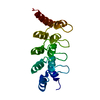
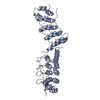
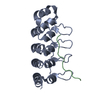
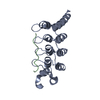
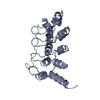
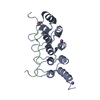
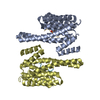
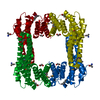
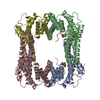
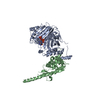
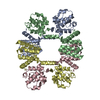
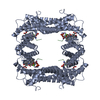
 PDBj
PDBj
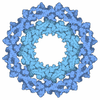
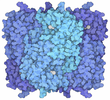
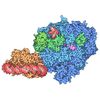
 Assembly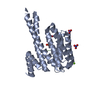
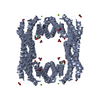
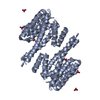

 Escherichia coli (E. coli) / References: UniProt: P61981
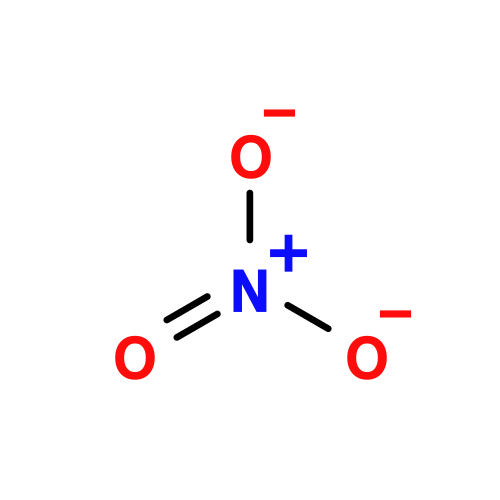 Mass: 62.005 Da / Num. of mol.: 3 / Source method: obtained synthetically / Formula: NO3
 Mass: 24.305 Da / Num. of mol.: 1 / Source method: obtained synthetically / Formula: Mg
 Mass: 18.015 Da / Num. of mol.: 138 / Source method: isolated from a natural source / Formula: H2O
 Sample preparation
 / Beamline: 19-ID / Wavelength: 0.97924 Å
 Processing