 Movie
Movie Controller

[English] 日本語
 Yorodumi
- PDB-9ovt: Heteromeric GluA1/A2 in the inactive state, composite map of LBD-TMD -
+ Open data

- Basic information
| Entry | Database: PDB / ID: 9ovt | ||||||||||||||||||||||||||||||
|---|---|---|---|---|---|---|---|---|---|---|---|---|---|---|---|---|---|---|---|---|---|---|---|---|---|---|---|---|---|---|---|
| Title | Heteromeric GluA1/A2 in the inactive state, composite map of LBD-TMD | ||||||||||||||||||||||||||||||
 Components Components |
| ||||||||||||||||||||||||||||||
 Keywords Keywords | MEMBRANE PROTEIN / GluA1A2 heterotetramer ZK iGluR | ||||||||||||||||||||||||||||||
| Function / homology |  Function and homology information Function and homology informationCargo concentration in the ER / cellular response to ammonium ion / axonal spine / COPII-mediated vesicle transport / positive regulation of locomotion involved in locomotory behavior / positive regulation of membrane potential / response to sucrose / regulation of monoatomic ion transmembrane transport / myosin V binding / cellular response to L-glutamate ...Cargo concentration in the ER / cellular response to ammonium ion / axonal spine / COPII-mediated vesicle transport / positive regulation of locomotion involved in locomotory behavior / positive regulation of membrane potential / response to sucrose / regulation of monoatomic ion transmembrane transport / myosin V binding / cellular response to L-glutamate / neuron spine / Trafficking of AMPA receptors / proximal dendrite / long-term synaptic depression / response to arsenic-containing substance / cellular response to dsRNA / ligand-gated calcium channel activity / dendritic spine membrane / beta-2 adrenergic receptor binding / Synaptic adhesion-like molecules / cellular response to peptide hormone stimulus / regulation of synaptic plasticity by chemical substance / spine synapse / spinal cord development / dendritic spine neck / dendritic spine cytoplasm / dendritic spine head / cellular response to amine stimulus / peptide hormone receptor binding / response to psychosocial stress / response to morphine / Activation of AMPA receptors / ligand-gated monoatomic cation channel activity / perisynaptic space / behavioral response to pain / neuronal cell body membrane / Trafficking of GluR2-containing AMPA receptors / response to lithium ion / AMPA glutamate receptor activity / protein kinase A binding / AMPA glutamate receptor clustering / regulation of receptor recycling / kainate selective glutamate receptor activity / neuronal action potential / immunoglobulin binding / adenylate cyclase binding / AMPA glutamate receptor complex / response to electrical stimulus / extracellularly glutamate-gated ion channel activity / ionotropic glutamate receptor complex / cellular response to glycine / asymmetric synapse / Unblocking of NMDA receptors, glutamate binding and activation / G-protein alpha-subunit binding / glutamate receptor binding / positive regulation of synaptic transmission / conditioned place preference / long-term memory / regulation of synaptic transmission, glutamatergic / postsynaptic density, intracellular component / response to fungicide / cytoskeletal protein binding / extracellular ligand-gated monoatomic ion channel activity / glutamate-gated receptor activity / cellular response to brain-derived neurotrophic factor stimulus / regulation of long-term synaptic depression / glutamate-gated calcium ion channel activity / synapse assembly / somatodendritic compartment / presynaptic active zone membrane / ionotropic glutamate receptor binding / ionotropic glutamate receptor signaling pathway / cellular response to amino acid stimulus / dendrite cytoplasm / excitatory synapse / ligand-gated monoatomic ion channel activity involved in regulation of presynaptic membrane potential / dendrite membrane / positive regulation of excitatory postsynaptic potential / dendritic shaft / SNARE binding / synaptic membrane / response to cocaine / PDZ domain binding / establishment of protein localization / neuromuscular junction / synaptic transmission, glutamatergic / protein tetramerization / long-term synaptic potentiation / receptor internalization / cerebral cortex development / transmitter-gated monoatomic ion channel activity involved in regulation of postsynaptic membrane potential / regulation of synaptic plasticity / response to nutrient levels / cellular response to growth factor stimulus / response to toxic substance / recycling endosome / postsynaptic density membrane / modulation of chemical synaptic transmission / response to peptide hormone / Schaffer collateral - CA1 synapse Similarity search - Function | ||||||||||||||||||||||||||||||
| Biological species |   Rattus norvegicus (Norway rat) Rattus norvegicus (Norway rat) | ||||||||||||||||||||||||||||||
| Method | ELECTRON MICROSCOPY / single particle reconstruction / cryo EM / Resolution: 3.43 Å | ||||||||||||||||||||||||||||||
 Authors Authors | Yen, L.Y. / Sobolevsky, A.I. / Newton, T.P. / Gangwar, S.P. | ||||||||||||||||||||||||||||||
| Funding support |  United States, 9items United States, 9items
| ||||||||||||||||||||||||||||||
 Citation Citation | Journal: Nat Commun / Year: 2026 Title: Auxiliary subunits reshape structural asymmetry and functional plasticity in heterotetrameric GluA1/A2 AMPA receptor core. Authors: Laura Y Yen / Thomas P Newton / Maria V Yelshanskaya / Muhammed Aktolun / Shanti Pal Gangwar / Rasmus P Clausen / Maria G Kurnikova / Alexander I Sobolevsky /  Abstract: AMPA-subtype ionotropic glutamate receptors (AMPARs) mediate the fast component of excitatory neurotransmission. They govern synaptic plasticity that underlies learning and memory, while their ...AMPA-subtype ionotropic glutamate receptors (AMPARs) mediate the fast component of excitatory neurotransmission. They govern synaptic plasticity that underlies learning and memory, while their dysregulation is implicated in numerous neurological disorders. The functional diversity of AMPARs arises from variations in their subunit composition and also their association with auxiliary subunits. While multiple structures of homomeric AMPARs have been reported, structural information for the heteromeric core - particularly in the absence of auxiliary subunits, which would serve as a functional and structural baseline - has been limited. Here, we report cryo-electron microscopy structures of GluA1/A2, the most abundant AMPAR di-heteromer in the brain, in the closed, open, and desensitized states. Using molecular dynamics (MD) simulations and cross-correlating structural and functional information, we find that auxiliary subunits increase the diameter of channel pore, which corresponds to larger conductance. Likewise, we find that recovery from desensitization slows with greater disruption of two-fold rotational symmetry of the ligand-binding domain dimer in the desensitized state. Both receptor activation and desensitization vary with the type and number of associated auxiliary proteins. These structures offer a foundation for uncovering how auxiliary subunits reshape structural asymmetry and functional plasticity in heterotetrameric AMPARs. | ||||||||||||||||||||||||||||||
| History |
|
- Structure visualization
| Structure viewer | Molecule: MolmilJmol/JSmol |
|---|
- Downloads & links
-Download
| PDBx/mmCIF format | 9ovt.cif.gz | 299.1 KB | Display | PDBx/mmCIF format |
|---|---|---|---|---|
| PDB format | pdb9ovt.ent.gz | 237.9 KB | Display | PDB format |
| PDBx/mmJSON format | 9ovt.json.gz | Tree view | PDBx/mmJSON format | |
| Others |  Other downloads Other downloads |
-Validation report
| Arichive directory | https://data.pdbj.org/pub/pdb/validation_reports/ov/9ovtftp://data.pdbj.org/pub/pdb/validation_reports/ov/9ovt | HTTPS FTP |
|---|
-Related structure data
| Related structure data |  70912MC  9ovuC  9ovvC  9ovwC C: citing same article ( M: map data used to model this data |
|---|---|
| Similar structure data |


-Links
 PDBj
PDBj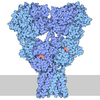


- Assembly
| Deposited unit | 
|
|---|---|
| 1 |
|
-Components
| #1: Protein | Mass: 48183.172 Da / Num. of mol.: 2 Source method: isolated from a genetically manipulated source Source: (gene. exp.) Rattus norvegicus (Norway rat) / Gene: Gria1, GluA1, Glur1 / Plasmid: pEG BacMam / Cell (production host): epithelial / Cell line (production host): HEK 293S GntI- / Organ (production host): kidney / Production host:  Homo sapiens (human) / Tissue (production host): kidney / References: UniProt: P19490 Homo sapiens (human) / Tissue (production host): kidney / References: UniProt: P19490#2: Protein | Mass: 47751.934 Da / Num. of mol.: 2 Source method: isolated from a genetically manipulated source Source: (gene. exp.) Rattus norvegicus (Norway rat) / Gene: Gria2, GluA2, Glur2 / Plasmid: pEG BacMam / Cell (production host): epithelial / Cell line (production host): HEK 293S GntI- / Organ (production host): kidney / Production host: Homo sapiens (human) / Tissue (production host): kidney / References: UniProt: P19491#3: Chemical | ChemComp-ZK1 / {[ 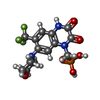 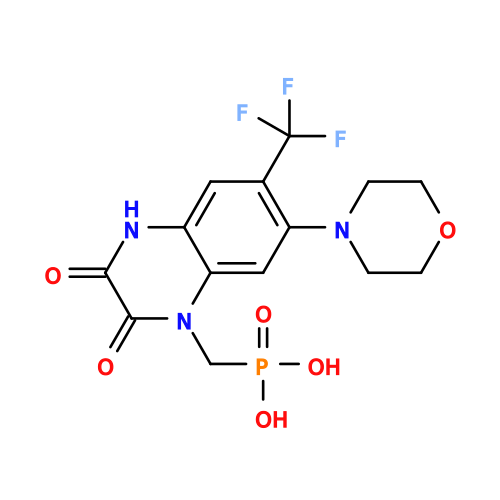 Mass: 409.254 Da / Num. of mol.: 4 / Source method: obtained synthetically / Formula: C14H15F3N3O6P / Feature type: SUBJECT OF INVESTIGATION / Comment: medication*YM Mass: 409.254 Da / Num. of mol.: 4 / Source method: obtained synthetically / Formula: C14H15F3N3O6P / Feature type: SUBJECT OF INVESTIGATION / Comment: medication*YM#4: Chemical |   Mass: 22.990 Da / Num. of mol.: 3 / Source method: obtained synthetically / Formula: Na Mass: 22.990 Da / Num. of mol.: 3 / Source method: obtained synthetically / Formula: Na#5: Water | ChemComp-HOH / |  Mass: 18.015 Da / Num. of mol.: 8 / Source method: isolated from a natural source / Formula: H2O Mass: 18.015 Da / Num. of mol.: 8 / Source method: isolated from a natural source / Formula: H2OHas ligand of interest | Y | Has protein modification | Y | |
|---|
-Experimental details
-Experiment
| Experiment | Method: ELECTRON MICROSCOPY |
|---|---|
| EM experiment | Aggregation state: PARTICLE / 3D reconstruction method: single particle reconstruction |
- Sample preparation
| Component | Name: Heteromeric GluA1A2 with competitive antagonist ZK / Type: COMPLEX / Entity ID: #1-#2 / Source: RECOMBINANT | |||||||||||||||||||||||||
|---|---|---|---|---|---|---|---|---|---|---|---|---|---|---|---|---|---|---|---|---|---|---|---|---|---|---|
| Molecular weight | Value: 0.556 MDa / Experimental value: NO | |||||||||||||||||||||||||
| Source (natural) | Organism: Rattus norvegicus (Norway rat) | |||||||||||||||||||||||||
| Source (recombinant) | Organism: Homo sapiens (human) / Strain: HEK 293S GntI- / Plasmid: pEG BacMam | |||||||||||||||||||||||||
| Buffer solution | pH: 8 Details: 150 mM NaCl, 20 mM Tris-HCl pH 8.0, and 0.05% digitonin, 100 uM ZK-200775 | |||||||||||||||||||||||||
| Buffer component |
| |||||||||||||||||||||||||
| Specimen | Conc.: 4.5 mg/ml / Embedding applied: NO / Shadowing applied: NO / Staining applied: NO / Vitrification applied: YES Details: The sample had compositional heterogeneity, with broken particles seen throughout. Otherwise, sample was monodisperse | |||||||||||||||||||||||||
| Specimen support | Details: 15 mA / Grid material: GOLD / Grid mesh size: 300 divisions/in. / Grid type: UltrAuFoil R1.2/1.3 | |||||||||||||||||||||||||
| Vitrification | Instrument: FEI VITROBOT MARK IV / Cryogen name: ETHANE / Humidity: 100 % / Chamber temperature: 298 K |
- Electron microscopy imaging
| Experimental equipment |  Model: Titan Krios / Image courtesy: FEI Company |
|---|---|
| Microscopy | Model: TFS KRIOS |
| Electron gun | Electron source:  FIELD EMISSION GUN / Accelerating voltage: 300 kV / Illumination mode: SPOT SCAN FIELD EMISSION GUN / Accelerating voltage: 300 kV / Illumination mode: SPOT SCAN |
| Electron lens | Mode: BRIGHT FIELD / Nominal defocus max: 2500 nm / Nominal defocus min: 1000 nm / Cs: 2.7 mm / C2 aperture diameter: 100 µm |
| Image recording | Electron dose: 45.7 e/Å2 / Film or detector model: GATAN K3 BIOQUANTUM (6k x 4k) |
- Processing
| EM software |
| ||||||||||||||||||||||||||||
|---|---|---|---|---|---|---|---|---|---|---|---|---|---|---|---|---|---|---|---|---|---|---|---|---|---|---|---|---|---|
| CTF correction | Type: PHASE FLIPPING AND AMPLITUDE CORRECTION | ||||||||||||||||||||||||||||
| Particle selection | Num. of particles selected: 5527903 | ||||||||||||||||||||||||||||
| Symmetry | Point symmetry: C2 (2 fold cyclic) | ||||||||||||||||||||||||||||
| 3D reconstruction | Resolution: 3.43 Å / Resolution method: FSC 0.143 CUT-OFF / Num. of particles: 216104 Details: this is a composite map; where required, consensus refinement parameters are entered Symmetry type: POINT | ||||||||||||||||||||||||||||
| Refinement | Stereochemistry target values: REAL-SPACE (WEIGHTED MAP SUM AT ATOM CENTERS) | ||||||||||||||||||||||||||||
| Refine LS restraints |
|
