 Movie
Movie Controller


+ Open data

- Basic information
| Entry | Database: PDB / ID: 9g8o | ||||||||||||||||||
|---|---|---|---|---|---|---|---|---|---|---|---|---|---|---|---|---|---|---|---|
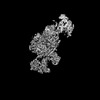
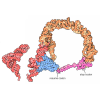
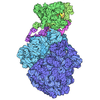
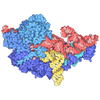
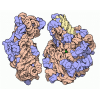
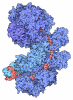
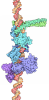
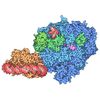
| Title | human 40S ribosome bound by a SKI238-exosome complex | ||||||||||||||||||
 Components Components |
| ||||||||||||||||||
 Keywords Keywords | RIBOSOME / RNA-binding / RNA-degradation / cytoplasm / helicase | ||||||||||||||||||
| Function / homology |  Function and homology information Function and homology informationDNA deamination / nucleolar exosome (RNase complex) / exoribonuclease II / exoribonuclease II activity / Dom34-Hbs1 complex / nuclear-transcribed mRNA catabolic process, no-go decay / CUT catabolic process / U1 snRNA 3'-end processing / Ski complex / U5 snRNA 3'-end processing ...DNA deamination / nucleolar exosome (RNase complex) / exoribonuclease II / exoribonuclease II activity / Dom34-Hbs1 complex / nuclear-transcribed mRNA catabolic process, no-go decay / CUT catabolic process / U1 snRNA 3'-end processing / Ski complex / U5 snRNA 3'-end processing / TRAMP-dependent tRNA surveillance pathway / exosome (RNase complex) / cytoplasmic exosome (RNase complex) / mRNA decay by 3' to 5' exoribonuclease / U4 snRNA 3'-end processing / nuclear polyadenylation-dependent rRNA catabolic process / poly(A)-dependent snoRNA 3'-end processing / Cdc73/Paf1 complex / nuclear exosome (RNase complex) / nuclear-transcribed mRNA catabolic process, 3'-5' exonucleolytic nonsense-mediated decay / negative regulation of myeloid cell differentiation / Tristetraprolin (TTP, ZFP36) binds and destabilizes mRNA / exonucleolytic trimming to generate mature 3'-end of 5.8S rRNA from tricistronic rRNA transcript (SSU-rRNA, 5.8S rRNA, LSU-rRNA) / nuclear-transcribed mRNA catabolic process, non-stop decay / ATF4 activates genes in response to endoplasmic reticulum stress / Butyrate Response Factor 1 (BRF1) binds and destabilizes mRNA / histone mRNA catabolic process / 3'-5' RNA helicase activity / nuclear mRNA surveillance / rRNA catabolic process / Nuclear RNA decay / 7S RNA binding / isotype switching / mRNA 3'-UTR AU-rich region binding / ribosome disassembly / RNA catabolic process / negative regulation of endoplasmic reticulum unfolded protein response / oxidized pyrimidine DNA binding / response to TNF agonist / positive regulation of base-excision repair / positive regulation of respiratory burst involved in inflammatory response / regulation of adenylate cyclase-activating G protein-coupled receptor signaling pathway / positive regulation of intrinsic apoptotic signaling pathway in response to DNA damage / positive regulation of gastrulation / protein tyrosine kinase inhibitor activity / KSRP (KHSRP) binds and destabilizes mRNA / IRE1-RACK1-PP2A complex / TNFR1-mediated ceramide production / positive regulation of Golgi to plasma membrane protein transport / maturation of 5.8S rRNA / nucleolus organization / positive regulation of ubiquitin-protein transferase activity / negative regulation of RNA splicing / positive regulation of DNA-templated transcription initiation / negative regulation of DNA repair / erythrocyte homeostasis / supercoiled DNA binding / regulation of establishment of cell polarity / rRNA modification in the nucleus and cytosol / oxidized purine DNA binding / NF-kappaB complex / negative regulation of intrinsic apoptotic signaling pathway in response to hydrogen peroxide / negative regulation of phagocytosis / ubiquitin-like protein conjugating enzyme binding / cytoplasmic translational initiation / nuclear chromosome / cytoplasmic side of rough endoplasmic reticulum membrane / mRNA catabolic process / Formation of the ternary complex, and subsequently, the 43S complex / ion channel inhibitor activity / laminin receptor activity / Association of TriC/CCT with target proteins during biosynthesis / negative regulation of myoblast fusion / Ribosomal scanning and start codon recognition / protein kinase A binding / Translation initiation complex formation / negative regulation of Wnt signaling pathway / fibroblast growth factor binding / BH3 domain binding / Protein hydroxylation / TOR signaling / mTORC1-mediated signalling / negative regulation of translational frameshifting / monocyte chemotaxis / PELO:HBS1L and ABCE1 dissociate a ribosome on a non-stop mRNA / SARS-CoV-1 modulates host translation machinery / regulation of cell division / positive regulation of GTPase activity / Peptide chain elongation / nuclear-transcribed mRNA catabolic process / Selenocysteine synthesis / negative regulation of protein binding / Formation of a pool of free 40S subunits / negative regulation of respiratory burst involved in inflammatory response / positive regulation of intrinsic apoptotic signaling pathway by p53 class mediator / protein serine/threonine kinase inhibitor activity / Eukaryotic Translation Termination / Dengue Virus Attachment and Entry / SRP-dependent cotranslational protein targeting to membrane / Response of EIF2AK4 (GCN2) to amino acid deficiency Similarity search - Function | ||||||||||||||||||
| Biological species |  Homo sapiens (human) Homo sapiens (human) Cricket paralysis virus Cricket paralysis virus | ||||||||||||||||||
| Method | ELECTRON MICROSCOPY / single particle reconstruction / cryo EM / Resolution: 3.4 Å | ||||||||||||||||||
 Authors Authors | Koegel, A. / Keidel, A. / Loukeri, M.J. / Kuhn, C.C. / Langer, L.M. / Schaefer, I.B. / Conti, E. | ||||||||||||||||||
| Funding support |  Germany, European Union, Germany, European Union,  Denmark, 5items Denmark, 5items
| ||||||||||||||||||
 Citation Citation | Journal: Nature / Year: 2024 Title: Structural basis of mRNA decay by the human exosome-ribosome supercomplex. Authors: Alexander Kögel / Achim Keidel / Matina-Jasemi Loukeri / Christopher C Kuhn / Lukas M Langer / Ingmar B Schäfer / Elena Conti / Abstract: The interplay between translation and mRNA decay is widespread in human cells. In quality-control pathways, exonucleolytic degradation of mRNA associated with translating ribosomes is mediated ...The interplay between translation and mRNA decay is widespread in human cells. In quality-control pathways, exonucleolytic degradation of mRNA associated with translating ribosomes is mediated largely by the cytoplasmic exosome, which includes the exoribonuclease complex EXO10 and the helicase complex SKI238 (refs. ). The helicase can extract mRNA from the ribosome and is expected to transfer it to the exoribonuclease core through a bridging factor, HBS1L3 (also known as SKI7), but the mechanisms of this molecular handover remain unclear. Here we reveal how human EXO10 is recruited by HBS1L3 (SKI7) to an active ribosome-bound SKI238 complex. We show that rather than a sequential handover, a direct physical coupling mechanism takes place, which culminates in the formation of a cytoplasmic exosome-ribosome supercomplex. Capturing the structure during active decay reveals a continuous path in which an RNA substrate threads from the 80S ribosome through the SKI2 helicase into the exoribonuclease active site of the cytoplasmic exosome complex. The SKI3 subunit of the complex directly binds to HBS1L3 (SKI7) and also engages a surface of the 40S subunit, establishing a recognition platform in collided disomes. Exosome and ribosome thus work together as a single structural and functional unit in co-translational mRNA decay, coordinating their activities in a transient supercomplex. | ||||||||||||||||||
| History |
|
- Structure visualization
| Structure viewer | Molecule: MolmilJmol/JSmol |
|---|
- Downloads & links
-Download
| PDBx/mmCIF format | 9g8o.cif.gz | 3.1 MB | Display | PDBx/mmCIF format |
|---|---|---|---|---|
| PDB format | pdb9g8o.ent.gz | Display | PDB format | |
| PDBx/mmJSON format | 9g8o.json.gz | Tree view | PDBx/mmJSON format | |
| Others |  Other downloads Other downloads |
-Validation report
| Arichive directory | https://data.pdbj.org/pub/pdb/validation_reports/g8/9g8oftp://data.pdbj.org/pub/pdb/validation_reports/g8/9g8o | HTTPS FTP |
|---|
-Related structure data
| Related structure data |  51134MC 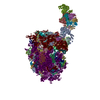 9g8mC 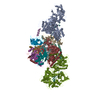 9g8nC 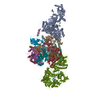 9g8pC 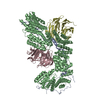 9g8qC 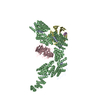 9g8rC M: map data used to model this data C: citing same article ( |
|---|---|
| Similar structure data |
-Links
 PDBj
PDBj
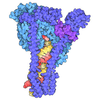

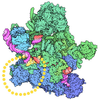
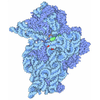
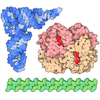
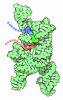
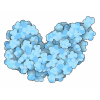
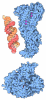
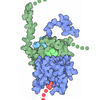
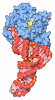
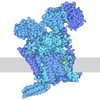

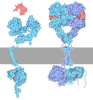
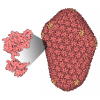
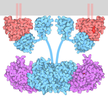
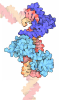
- Assembly
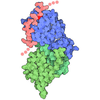
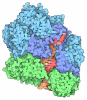
| Deposited unit | 
|
|---|---|
| 1 |
|
-Components
-Protein , 7 types, 8 molecules BCDAEMSfSg
| #1: Protein | Mass: 176064.750 Da / Num. of mol.: 1 Source method: isolated from a genetically manipulated source Source: (gene. exp.) Homo sapiens (human) / Gene: SKIC3, KIAA0372, TTC37 / Production host:  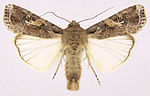 Spodoptera frugiperda (fall armyworm) / References: UniProt: Q6PGP7 Spodoptera frugiperda (fall armyworm) / References: UniProt: Q6PGP7 | ||||||||||
|---|---|---|---|---|---|---|---|---|---|---|---|
| #2: Protein | Mass: 33617.465 Da / Num. of mol.: 2 Source method: isolated from a genetically manipulated source Source: (gene. exp.) Homo sapiens (human) / Gene: WDR61 / Production host: Spodoptera frugiperda (fall armyworm) / References: UniProt: Q9GZS3#9: Protein | | Mass: 137913.688 Da / Num. of mol.: 1 Source method: isolated from a genetically manipulated source Source: (gene. exp.) Homo sapiens (human) / Gene: SKIV2L, DDX13, SKI2W, SKIV2, W / Production host: Spodoptera frugiperda (fall armyworm)References: UniProt: Q15477, Hydrolases; Acting on acid anhydrides; Acting on acid anhydrides to facilitate cellular and subcellular movement #10: Protein | | Mass: 30196.131 Da / Num. of mol.: 1 Source method: isolated from a genetically manipulated source Source: (gene. exp.) Homo sapiens (human) / Gene: HBS1L, HBS1, KIAA1038 / Production host:   Escherichia coli (E. coli) Escherichia coli (E. coli)References: UniProt: Q9Y450, Hydrolases; Acting on acid anhydrides; Acting on GTP to facilitate cellular and subcellular movement #16: Protein | | Mass: 125229.984 Da / Num. of mol.: 1 Source method: isolated from a genetically manipulated source Source: (gene. exp.) Homo sapiens (human) / Gene: DIS3L, DIS3L1, KIAA1955 / Production host: Escherichia coli (E. coli) / References: UniProt: Q8TF46, exoribonuclease II#49: Protein | | Mass: 18004.041 Da / Num. of mol.: 1 / Source method: isolated from a natural source / Source: (natural) Homo sapiens (human) / References: UniProt: P62979#50: Protein | | Mass: 35115.652 Da / Num. of mol.: 1 / Source method: isolated from a natural source / Source: (natural) Homo sapiens (human) / References: UniProt: P63244 |
-Exosome complex component ... , 9 types, 9 molecules FJKLNOGHI
| #3: Protein | Mass: 32216.762 Da / Num. of mol.: 1 Source method: isolated from a genetically manipulated source Source: (gene. exp.) Homo sapiens (human) / Gene: EXOSC7, KIAA0116, RRP42 / Production host: Escherichia coli (E. coli) / References: UniProt: Q15024 |
|---|---|
| #4: Protein | Mass: 21835.100 Da / Num. of mol.: 1 Source method: isolated from a genetically manipulated source Source: (gene. exp.) Homo sapiens (human) / Gene: EXOSC1, CSL4, CGI-108 / Production host: Escherichia coli (E. coli) / References: UniProt: Q9Y3B2 |
| #5: Protein | Mass: 49370.312 Da / Num. of mol.: 1 Source method: isolated from a genetically manipulated source Source: (gene. exp.) Homo sapiens (human) / Gene: EXOSC9, PMSCL1 / Production host: Escherichia coli (E. coli) / References: UniProt: Q06265 |
| #6: Protein | Mass: 30429.893 Da / Num. of mol.: 1 Source method: isolated from a genetically manipulated source Source: (gene. exp.) Homo sapiens (human) / Gene: EXOSC8, OIP2, RRP43 / Production host: Escherichia coli (E. coli) / References: UniProt: Q96B26 |
| #7: Protein | Mass: 26416.996 Da / Num. of mol.: 1 Source method: isolated from a genetically manipulated source Source: (gene. exp.) Homo sapiens (human) / Gene: EXOSC4, RRP41, SKI6 / Production host: Escherichia coli (E. coli) / References: UniProt: Q9NPD3 |
| #8: Protein | Mass: 25636.312 Da / Num. of mol.: 1 Source method: isolated from a genetically manipulated source Source: (gene. exp.) Homo sapiens (human) / Gene: EXOSC5, CML28, RRP46 / Production host: Escherichia coli (E. coli) / References: UniProt: Q9NQT4 |
| #11: Protein | Mass: 28267.127 Da / Num. of mol.: 1 Source method: isolated from a genetically manipulated source Source: (gene. exp.) Homo sapiens (human) / Gene: EXOSC6, MTR3 / Production host: Escherichia coli (E. coli) / References: UniProt: Q5RKV6 |
| #12: Protein | Mass: 29940.502 Da / Num. of mol.: 1 Source method: isolated from a genetically manipulated source Source: (gene. exp.) Homo sapiens (human) / Gene: EXOSC3, RRP40, CGI-102 / Production host: Escherichia coli (E. coli) / References: UniProt: Q9NQT5 |
| #13: Protein | Mass: 33190.355 Da / Num. of mol.: 1 Source method: isolated from a genetically manipulated source Source: (gene. exp.) Homo sapiens (human) / Gene: EXOSC2, RRP4 / Production host: Escherichia coli (E. coli) / References: UniProt: Q13868 |
-RNA chain , 2 types, 2 molecules XS2
| #14: RNA chain | Mass: 79333.953 Da / Num. of mol.: 1 / Source method: obtained synthetically / Source: (synth.) Cricket paralysis virus |
|---|---|
| #17: RNA chain | Mass: 602752.875 Da / Num. of mol.: 1 / Source method: isolated from a natural source / Source: (natural) Homo sapiens (human) |
-Protein/peptide , 1 types, 1 molecules Ln
| #15: Protein/peptide | Mass: 3473.451 Da / Num. of mol.: 1 / Source method: isolated from a natural source / Source: (natural) Homo sapiens (human) / References: UniProt: P62945 |
|---|
+40S ribosomal protein ... , 31 types, 31 molecules SASBSCSDSESFSGSHSISJSKSLSMSNSOSPSQSRSSSTSUSVSWSXSYSZSaSbScSdSe
-Details
| Has protein modification | N |
|---|
-Experimental details
-Experiment
| Experiment | Method: ELECTRON MICROSCOPY |
|---|---|
| EM experiment | Aggregation state: PARTICLE / 3D reconstruction method: single particle reconstruction |
- Sample preparation
| Component | Name: human 40S ribosome bound by a SKI238-exosome complex / Type: RIBOSOME Entity ID: #14, #34-#39, #41, #44, #46, #15, #47, #49-#50, #20, #24, #17, #27, #30, #18, #31, #19, #32, #21, #40, #22, #42, #9, #1-#2, #23, #43, #3, #11-#13, #4-#5, #10, #16, #6-#8, #25, #45, #26, #48, #28-#29, #33 Source: NATURAL |
|---|---|
| Molecular weight | Experimental value: NO |
| Source (natural) | Organism: Homo sapiens (human) |
| Source (recombinant) | Organism: Escherichia coli (E. coli) |
| Buffer solution | pH: 7.4 |
| Specimen | Embedding applied: NO / Shadowing applied: NO / Staining applied: NO / Vitrification applied: YES |
| Specimen support | Grid mesh size: 200 divisions/in. / Grid type: Quantifoil R2/1 |
| Vitrification | Cryogen name: ETHANE-PROPANE |
- Electron microscopy imaging
| Experimental equipment |  Model: Titan Krios / Image courtesy: FEI Company |
|---|---|
| Microscopy | Model: FEI TITAN KRIOS |
| Electron gun | Electron source:  FIELD EMISSION GUN / Accelerating voltage: 300 kV / Illumination mode: FLOOD BEAM FIELD EMISSION GUN / Accelerating voltage: 300 kV / Illumination mode: FLOOD BEAM |
| Electron lens | Mode: BRIGHT FIELD / Nominal defocus max: 2400 nm / Nominal defocus min: 600 nm |
| Image recording | Electron dose: 64.2 e/Å2 / Film or detector model: GATAN K3 BIOQUANTUM (6k x 4k) |
- Processing
| EM software | Name: PHENIX / Version: 1.20.1_4487: / Category: model refinement | ||||||||||||||||||||||||
|---|---|---|---|---|---|---|---|---|---|---|---|---|---|---|---|---|---|---|---|---|---|---|---|---|---|
| CTF correction | Type: PHASE FLIPPING AND AMPLITUDE CORRECTION | ||||||||||||||||||||||||
| 3D reconstruction | Resolution: 3.4 Å / Resolution method: FSC 0.143 CUT-OFF / Num. of particles: 53460 / Symmetry type: POINT | ||||||||||||||||||||||||
| Refine LS restraints |
|
