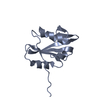
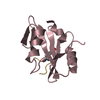
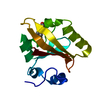
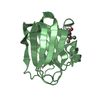
[English] 日本語
Yorodumi
- PDB-5tq1: Phospholipase C gamma-1 C-terminal SH2 domain bound to a phosphop... -

+
Open data


ID or keywords:

Loading...

-
Basic information

Entry
Database: PDB / ID: 5tq1
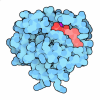
TitlePhospholipase C gamma-1 C-terminal SH2 domain bound to a phosphopeptide derived from the insulin receptor
Components
  • 1-phosphatidylinositol 4,5-bisphosphate phosphodiesterase gamma-1
  • Insulin receptor
KeywordsHYDROLASE / SH2 / Phospholipase / phosphopeptide
Function / homology
Function and homology information


response to vanadate(3-) / Insulin receptor signalling cascade / Signaling by Insulin receptor / IRS activation / : / 3-phosphoinositide-dependent protein kinase binding / yolk / embryonic liver development / cellular response to zinc ion starvation / Insulin receptor recycling ...response to vanadate(3-) / Insulin receptor signalling cascade / Signaling by Insulin receptor / IRS activation / : / 3-phosphoinositide-dependent protein kinase binding / yolk / embryonic liver development / cellular response to zinc ion starvation / Insulin receptor recycling / phosphatidylinositol phospholipase C activity / Signal attenuation / phosphoinositide phospholipase C / PI5P, PP2A and IER3 Regulate PI3K/AKT Signaling / lipoic acid binding / positive regulation of glycoprotein biosynthetic process / negative regulation of glycogen biosynthetic process / response to resveratrol / phosphatidylinositol metabolic process / regulation of female gonad development / regulation of hydrogen peroxide metabolic process / positive regulation of meiotic cell cycle / phosphatidylinositol-4,5-bisphosphate phospholipase C activity / insulin-like growth factor II binding / positive regulation of developmental growth / male sex determination / COP9 signalosome / nuclear lumen / insulin receptor complex / insulin-like growth factor I binding / insulin receptor activity / positive regulation of protein-containing complex disassembly / exocrine pancreas development / response to manganese ion / phospholipid catabolic process / response to vitamin D / dendritic spine maintenance / insulin binding / regulation of gluconeogenesis / adrenal gland development / cargo receptor activity / PTB domain binding / negative regulation of feeding behavior / response to starvation / response to food / response to testosterone / neuronal cell body membrane / phosphatidylinositol-mediated signaling / positive regulation of respiratory burst / amyloid-beta clearance / insulin receptor substrate binding / regulation of embryonic development / positive regulation of epithelial cell migration / positive regulation of receptor internalization / cellular response to vascular endothelial growth factor stimulus / response to tumor necrosis factor / positive regulation of phosphorylation / epidermis development / positive regulation of glycogen biosynthetic process / protein kinase activator activity / response to glucose / fat cell differentiation / heart morphogenesis / phosphatidylinositol 3-kinase binding / insulin-like growth factor receptor binding / ruffle / release of sequestered calcium ion into cytosol / neuron projection maintenance / positive regulation of mitotic nuclear division / response to hormone / liver regeneration / guanyl-nucleotide exchange factor activity / dendrite membrane / response to glucocorticoid / receptor-mediated endocytosis / cellular response to epidermal growth factor stimulus / cerebellum development / positive regulation of glycolytic process / animal organ morphogenesis / response to activity / positive regulation of D-glucose import across plasma membrane / hippocampus development / liver development / receptor protein-tyrosine kinase / response to nutrient levels / response to insulin / receptor internalization / caveola / cellular response to growth factor stimulus / male gonad development / ruffle membrane / epidermal growth factor receptor signaling pathway / cellular response to insulin stimulus / positive regulation of nitric oxide biosynthetic process / insulin receptor signaling pathway / late endosome / response to estradiol / nuclear envelope / lamellipodium / glucose homeostasis
Similarity search - Function
1-phosphatidylinositol 4,5-bisphosphate phosphodiesterase gamma-1, SH3 domain / Phosphatidylinositol-4, 5-bisphosphate phosphodiesterase gamma / PLC-gamma, C-terminal SH2 domain / PLC-gamma, N-terminal SH2 domain / : / : / PLCG EF-hand motif 1 / PLCG EF-hand motif 2 / Phosphoinositide phospholipase C family / Phospholipase C, phosphatidylinositol-specific, Y domain ...1-phosphatidylinositol 4,5-bisphosphate phosphodiesterase gamma-1, SH3 domain / Phosphatidylinositol-4, 5-bisphosphate phosphodiesterase gamma / PLC-gamma, C-terminal SH2 domain / PLC-gamma, N-terminal SH2 domain / : / : / PLCG EF-hand motif 1 / PLCG EF-hand motif 2 / Phosphoinositide phospholipase C family / Phospholipase C, phosphatidylinositol-specific, Y domain / Phosphatidylinositol-specific phospholipase C, Y domain / Phosphatidylinositol-specific phospholipase Y-box domain profile. / Phospholipase C, catalytic domain (part); domain Y / Phosphatidylinositol-specific phospholipase C, X domain / Phosphatidylinositol-specific phospholipase C, X domain / Phospholipase C, catalytic domain (part); domain X / Phosphatidylinositol-specific phospholipase X-box domain profile. / Insulin receptor, trans-membrane domain / Insulin receptor trans-membrane segment / PLC-like phosphodiesterase, TIM beta/alpha-barrel domain superfamily / Tyrosine-protein kinase, insulin-like receptor / SH2 domain / SHC Adaptor Protein / Tyrosine-protein kinase, receptor class II, conserved site / Receptor tyrosine kinase class II signature. / Protein kinase C conserved region 2 (CalB) / C2 domain / C2 domain / C2 domain profile. / Receptor L-domain / Furin-like cysteine-rich domain / Receptor L-domain superfamily / Furin-like cysteine rich region / Receptor L domain / Furin-like repeat / Furin-like repeats / PH domain / C2 domain superfamily / PH domain profile. / Pleckstrin homology domain. / Pleckstrin homology domain / Growth factor receptor cysteine-rich domain superfamily / SH3 domain / : / Fibronectin type 3 domain / SH2 domain / Fibronectin type-III domain profile. / Fibronectin type III / Fibronectin type III superfamily / Src homology 2 (SH2) domain profile. / Src homology 2 domains / SH2 domain / Src homology 3 domains / SH2 domain superfamily / SH3-like domain superfamily / Src homology 3 (SH3) domain profile. / SH3 domain / EF-Hand 1, calcium-binding site / EF-hand calcium-binding domain. / EF-hand calcium-binding domain profile. / EF-hand domain / EF-hand domain pair / Tyrosine-protein kinase, catalytic domain / Tyrosine kinase, catalytic domain / Tyrosine protein kinases specific active-site signature. / PH-like domain superfamily / Tyrosine-protein kinase, active site / Protein tyrosine and serine/threonine kinase / Serine-threonine/tyrosine-protein kinase, catalytic domain / Protein kinase, ATP binding site / Protein kinases ATP-binding region signature. / Immunoglobulin-like fold / Protein kinase domain profile. / Protein kinase domain / Protein kinase-like domain superfamily / 2-Layer Sandwich / Alpha Beta
Similarity search - Domain/homology
1-phosphatidylinositol 4,5-bisphosphate phosphodiesterase gamma-1 / Insulin receptor / Insulin receptor
Similarity search - Component
Biological speciesBos taurus (domestic cattle)
Rattus norvegicus (Norway rat)
MethodX-RAY DIFFRACTION / SYNCHROTRON / MOLECULAR REPLACEMENT / molecular replacement / Resolution: 1.485 Å
AuthorsWuttke, D.S. / McKercher, M.A.
Funding support United States, 1items
OrganizationGrant numberCountry
National Science Foundation (NSF, United States)MCB1121842 United States
CitationJournal: Biochemistry / Year: 2017
Title: Multimodal Recognition of Diverse Peptides by the C-Terminal SH2 Domain of Phospholipase C-gamma 1 Protein.
Authors: McKercher, M.A. / Guan, X. / Tan, Z. / Wuttke, D.S.
History
DepositionOct 21, 2016Deposition site: RCSB / Processing site: RCSB
Revision 1.0Apr 19, 2017Provider: repository / Type: Initial release
Revision 1.1Apr 26, 2017Group: Database references
Revision 1.2May 10, 2017Group: Database references
Revision 1.3Sep 27, 2017Group: Author supporting evidence / Category: pdbx_audit_support / Item: _pdbx_audit_support.funding_organization
Revision 1.4Nov 27, 2019Group: Author supporting evidence / Category: pdbx_audit_support / Item: _pdbx_audit_support.funding_organization
Revision 1.5Oct 4, 2023Group: Data collection / Database references / Refinement description
Category: chem_comp_atom / chem_comp_bond ...chem_comp_atom / chem_comp_bond / database_2 / pdbx_initial_refinement_model
Item: _database_2.pdbx_DOI / _database_2.pdbx_database_accession
Revision 1.6Nov 15, 2023Group: Data collection / Category: chem_comp_atom / chem_comp_bond / Item: _chem_comp_atom.atom_id / _chem_comp_bond.atom_id_2
Revision 1.7Nov 20, 2024Group: Structure summary / Category: pdbx_entry_details / pdbx_modification_feature

-
Structure visualization

Structure viewerMolecule:
MolmilJmol/JSmol

Downloads & links

-
Assembly

Deposited unit
A: 1-phosphatidylinositol 4,5-bisphosphate phosphodiesterase gamma-1
B: Insulin receptor


Theoretical massNumber of molelcules
Total (without water)13,3772
Polymers13,3772
Non-polymers00
Water2,936163
1


  • Idetical with deposited unit
  • defined by author&software
TypeNameSymmetry operationNumber
identity operation1_555x,y,z1
Buried area830 Å2
ΔGint-4 kcal/mol
Surface area6660 Å2
MethodPISA
Unit cell
Length a, b, c (Å)34.010, 55.140, 58.665
Angle α, β, γ (deg.)90.000, 90.000, 90.000
Int Tables number19
Space group name H-MP212121

-
Components

#1: Protein 1-phosphatidylinositol 4,5-bisphosphate phosphodiesterase gamma-1 / PLC-148 / Phosphoinositide phospholipase C-gamma-1 / Phospholipase C-II / PLC-II / Phospholipase C- ...PLC-148 / Phosphoinositide phospholipase C-gamma-1 / Phospholipase C-II / PLC-II / Phospholipase C-gamma-1 / PLC-gamma-1


Mass: 11989.685 Da / Num. of mol.: 1 / Fragment: UNP residues 663-759
Source method: isolated from a genetically manipulated source
Source: (gene. exp.) Bos taurus (domestic cattle) / Gene: PLCG1 / Plasmid: pET15b / Cell line (production host): BL21(DE3) / Production host: Escherichia coli (E. coli)
References: UniProt: P08487, phosphoinositide phospholipase C
#2: Protein/peptide Insulin receptor


Mass: 1387.340 Da / Num. of mol.: 1 / Fragment: UNP residues 9-19 / Source method: obtained synthetically / Source: (synth.) Rattus norvegicus (Norway rat) / References: UniProt: Q9R1H1, UniProt: P15127*PLUS
#3: Water ChemComp-HOH / water


Mass: 18.015 Da / Num. of mol.: 163 / Source method: isolated from a natural source / Formula: H2O
Has protein modificationY

-
Experimental details

-
Experiment

ExperimentMethod: X-RAY DIFFRACTION / Number of used crystals: 1

-
Sample preparation

CrystalDensity Matthews: 2.12 Å3/Da / Density % sol: 42.02 %
Crystal growTemperature: 277 K / Method: vapor diffusion, hanging drop / pH: 9 / Details: 0.1M Tris (pH 9.0), 30% PEG MME 2000

-
Data collection

DiffractionMean temperature: 100 K
Diffraction sourceSource: SYNCHROTRON / Site: ALS / Beamline: 8.2.2 / Wavelength: 1 Å
DetectorType: ADSC QUANTUM 315r / Detector: CCD / Date: Dec 10, 2014
RadiationProtocol: SINGLE WAVELENGTH / Monochromatic (M) / Laue (L): M / Scattering type: x-ray
Radiation wavelengthWavelength: 1 Å / Relative weight: 1
ReflectionResolution: 1.485→58.665 Å / Num. all: 18758 / Num. obs: 18758 / % possible obs: 99.5 % / Redundancy: 5.5 % / Biso Wilson estimate: 15.76 Å2 / Rpim(I) all: 0.024 / Rrim(I) all: 0.064 / Rsym value: 0.059 / Net I/av σ(I): 7.218 / Net I/σ(I): 16.5 / Num. measured all: 104032
Reflection shell
Resolution (Å)Redundancy (%)Rmerge(I) obsMean I/σ(I) obsDiffraction-ID% possible all
1.485-1.563.30.2232.2197.5
1.56-1.664.30.1434.7199.4
1.66-1.774.20.1016.6199.8
1.77-1.924.30.096.2199.9
1.92-2.14.30.0757.31100
2.1-2.358.60.0718.31100
2.35-2.718.50.06210199.9
2.71-3.328.20.069.6199.8
3.32-4.697.30.05211.81100
4.69-58.6657.10.04114.6198.7

-
Phasing

PhasingMethod: molecular replacement
Phasing MRModel details: Phaser MODE: MR_AUTO
Highest resolutionLowest resolution
Rotation1.5 Å29.33 Å
Translation1.5 Å29.33 Å

-
Processing

Software
NameVersionClassification
SCALA3.3.20data scaling
PHASER2.3.0phasing
PHENIX1.10.1_2155refinement
PDB_EXTRACT3.2data extraction
MOSFLMdata reduction
RefinementMethod to determine structure: MOLECULAR REPLACEMENT
Starting model: 4K44
Resolution: 1.485→29.332 Å / SU ML: 0.18 / Cross valid method: THROUGHOUT / σ(F): 1.34 / Phase error: 20.2
RfactorNum. reflection% reflection
Rfree0.2099 929 4.97 %
Rwork0.1718 --
obs0.1736 18704 99.26 %
Solvent computationShrinkage radii: 0.9 Å / VDW probe radii: 1.11 Å
Displacement parametersBiso max: 100.24 Å2 / Biso mean: 21.0886 Å2 / Biso min: 6.28 Å2
Refinement stepCycle: final / Resolution: 1.485→29.332 Å
ProteinNucleic acidLigandSolventTotal
Num. atoms906 0 0 170 1076
Biso mean---31.05 -
Num. residues----109
Refine LS restraints
Refine-IDTypeDev idealNumber
X-RAY DIFFRACTIONf_bond_d0.004982
X-RAY DIFFRACTIONf_angle_d0.8341330
X-RAY DIFFRACTIONf_chiral_restr0.076133
X-RAY DIFFRACTIONf_plane_restr0.004175
X-RAY DIFFRACTIONf_dihedral_angle_d20.444387
LS refinement shell

Refine-ID: X-RAY DIFFRACTION / Total num. of bins used: 7

Resolution (Å)Rfactor RfreeNum. reflection RfreeRfactor RworkNum. reflection RworkNum. reflection all% reflection obs (%)
1.4845-1.56280.26841190.21722432255197
1.5628-1.66070.24171350.19172483261899
1.6607-1.78890.22511280.185925432671100
1.7889-1.96890.22511350.183625062641100
1.9689-2.25370.21651340.162325482682100
2.2537-2.8390.19161370.174625782715100
2.839-29.33820.19931410.160726852826100

+
About Yorodumi

-
News

-
Feb 9, 2022. New format data for meta-information of EMDB entries

New format data for meta-information of EMDB entries

  • Version 3 of the EMDB header file is now the official format.
  • The previous official version 1.9 will be removed from the archive.

Related info.:EMDB header

External links:wwPDB to switch to version 3 of the EMDB data model

-
Aug 12, 2020. Covid-19 info

Covid-19 info

URL: https://pdbj.org/emnavi/covid19.php

New page: Covid-19 featured information page in EM Navigator.

Related info.:Covid-19 info / Mar 5, 2020. Novel coronavirus structure data

+
Mar 5, 2020. Novel coronavirus structure data

Novel coronavirus structure data

Related info.:Yorodumi Speices / Aug 12, 2020. Covid-19 info

External links:COVID-19 featured content - PDBj / Molecule of the Month (242):Coronavirus Proteases

+
Jan 31, 2019. EMDB accession codes are about to change! (news from PDBe EMDB page)

EMDB accession codes are about to change! (news from PDBe EMDB page)

  • The allocation of 4 digits for EMDB accession codes will soon come to an end. Whilst these codes will remain in use, new EMDB accession codes will include an additional digit and will expand incrementally as the available range of codes is exhausted. The current 4-digit format prefixed with “EMD-” (i.e. EMD-XXXX) will advance to a 5-digit format (i.e. EMD-XXXXX), and so on. It is currently estimated that the 4-digit codes will be depleted around Spring 2019, at which point the 5-digit format will come into force.
  • The EM Navigator/Yorodumi systems omit the EMD- prefix.

Related info.:Q: What is EMD? / ID/Accession-code notation in Yorodumi/EM Navigator

External links:EMDB Accession Codes are Changing Soon! / Contact to PDBj

+
Jul 12, 2017. Major update of PDB

Major update of PDB

  • wwPDB released updated PDB data conforming to the new PDBx/mmCIF dictionary.
  • This is a major update changing the version number from 4 to 5, and with Remediation, in which all the entries are updated.
  • In this update, many items about electron microscopy experimental information are reorganized (e.g. em_software).
  • Now, EM Navigator and Yorodumi are based on the updated data.

External links:wwPDB Remediation / Enriched Model Files Conforming to OneDep Data Standards Now Available in the PDB FTP Archive

-
Yorodumi

Thousand views of thousand structures

  • Yorodumi is a browser for structure data from EMDB, PDB, SASBDB, etc.
  • This page is also the successor to EM Navigator detail page, and also detail information page/front-end page for Omokage search.
  • The word "yorodu" (or yorozu) is an old Japanese word meaning "ten thousand". "mi" (miru) is to see.

Related info.:EMDB / PDB / SASBDB / Comparison of 3 databanks / Yorodumi Search / Aug 31, 2016. New EM Navigator & Yorodumi / Yorodumi Papers / Jmol/JSmol / Function and homology information / Changes in new EM Navigator and Yorodumi

Read more